


Important: This tool performs a standard percentage calculation based on the numbers you enter. It is not medical advice and does not evaluate whether any particular rate or amount of weight loss is healthy for you. Talk to a healthcare provider before starting a weight loss plan, especially for larger or faster changes.
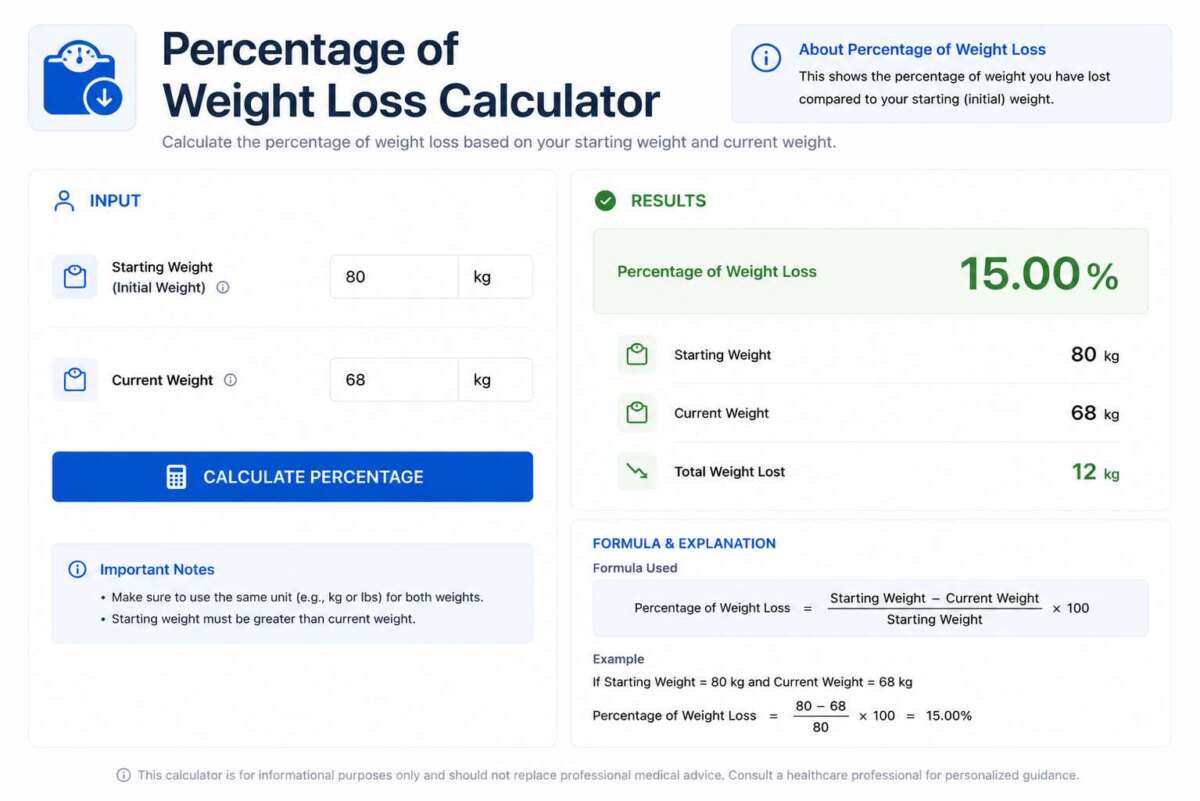
The Percentage Weight Loss Calculator covers three common calculations. Use the % Lost tab to find what percentage of your starting weight you’ve lost, the Goal Weight tab to find the weight that corresponds to a target percentage loss, or the Progress Tracker tab to see how far along you are toward a specific goal weight.
Table of Contents
- Percentage Weight Loss Calculator
- The Percentage Weight Loss Formula
- Why Percentage Matters More Than Pounds or Kilos
- What’s Considered a Reasonable Rate of Loss
- Frequently Asked Questions
Percentage Weight Loss Calculator
Select a tab below. Enter weights in the same unit (lbs or kg) — the unit itself doesn’t affect the percentage.
The Percentage Weight Loss Formula
% Weight Loss = [(Starting Weight − Current Weight) ÷ Starting Weight] × 100
To find a goal weight for a target percentage instead, the formula is rearranged: Goal Weight = Starting Weight × (1 − Target % ÷ 100). Both calculations always divide by the original starting weight, never the current or goal weight — this is the most common source of error when calculating by hand.
Why Percentage Matters More Than Pounds or Kilos
Losing 20 lbs means something very different for a 150 lb person than for a 300 lb person — the first case represents a much larger relative change. Percentage weight loss standardizes this, which is why it’s the metric commonly used in clinical research and healthcare settings to describe meaningful weight change (for example, a 5-10% loss is often referenced as a threshold associated with measurable health improvements), rather than a fixed number of pounds or kilos that doesn’t account for starting size.
What’s Considered a Reasonable Rate of Loss
General guidance from health organizations often frames a gradual, sustainable pace — commonly around 1-2 lbs (about 0.5-1 kg) per week for most adults — as more likely to be maintained long-term than rapid loss. Individual circumstances vary considerably, and any specific target or timeline should be discussed with a healthcare provider rather than derived solely from a percentage calculation.
Frequently Asked Questions
Do I divide by starting weight or current weight?
Always divide by the starting (original) weight. This is the most common mistake in manual calculations — dividing by current weight instead will produce a different, incorrect percentage, since the two numbers represent different reference points.
Does it matter if I use pounds or kilograms?
No, as long as both the starting and current weight are entered in the same unit. Since the formula is a ratio, the unit cancels out and the resulting percentage is identical whether you use pounds or kilograms.
What percentage of weight loss is considered significant?
This varies by context and individual health circumstances, and is best discussed with a healthcare provider rather than treated as a fixed universal number. Some clinical research references a 5-10% loss as associated with measurable health markers for certain individuals, but what’s meaningful or appropriate depends on personal health status and goals.
Can this calculator tell me if my rate of weight loss is healthy?
No. This tool only performs the percentage math based on the weights you enter — it doesn’t evaluate timeframes, rate of loss, or whether a given change is appropriate for your individual health situation. A healthcare provider is the right resource for that kind of assessment.
As an Amazon Associate, We earn from qualifying purchases. When you purchase a product through Amazon links on pulsefitguide.com, we may earn a small commission at no extra cost to you. This helps support the site and keep our content free.
