


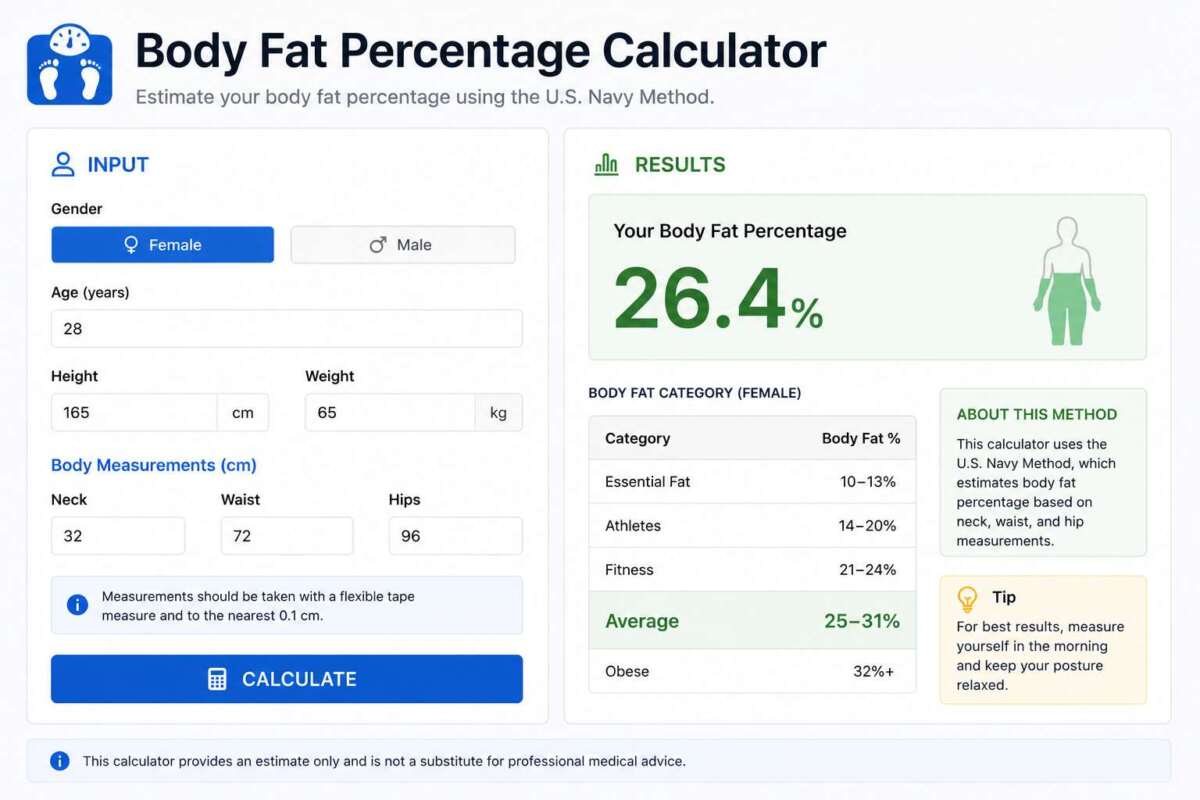
The Navy Body Fat Percentage Calculator estimates body fat using the U.S. Navy circumference method — neck, waist, and (for women) hip measurements plus height, no calipers or scale required. It’s the same formula the Navy has used for decades to estimate body composition for fitness standards, and it remains one of the most accessible reasonably accurate methods available without specialized equipment.
Use the Navy Method tab to calculate your body fat percentage from measurements, the Fat Mass & Lean Mass tab to break your weight down into fat and lean components, or the Progress Tracker tab to compare two sets of measurements over time — instantly.
Table of Contents
- Body Fat Percentage Calculator (Navy Method)
- What Is the U.S. Navy Body Fat Method?
- The Navy Method Formula Explained
- How to Measure Neck, Waist, and Hip Correctly
- Body Fat Percentage Categories
- Navy Method vs. Other Body Fat Measurement Methods
- Limitations of the Navy Method
- Frequently Asked Questions
Body Fat Percentage Calculator (Navy Method)
Select a tab below to calculate body fat percentage, break down fat vs. lean mass, or track changes over time. Measure in inches for the most direct match to the original Navy formula, or switch to centimeters — the calculator converts automatically.
What Is the U.S. Navy Body Fat Method?
The Navy method is a body fat estimation formula developed for the U.S. Navy to assess body composition as part of fitness standards, using simple circumference measurements (neck, waist, and for women, hip) combined with height — no calipers, water displacement tank, or DEXA scan required. It's remained popular well beyond military use because it only requires a flexible tape measure, making it one of the most accessible reasonably accurate body fat estimation methods available for home use.
The Navy Method Formula Explained
The formulas (using inches and base-10 logarithm) are:
Men: Body Fat % = 495 ÷ (1.0324 − 0.19077 × log₁₀(waist − neck) + 0.15456 × log₁₀(height)) − 450
Women: Body Fat % = 495 ÷ (1.29579 − 0.35004 × log₁₀(waist + hip − neck) + 0.22100 × log₁₀(height)) − 450
The formula is built around waist circumference relative to neck circumference (and hip, for women) as a proxy for abdominal fat, adjusted for overall body frame using height. It was statistically derived by comparing these easy-to-measure circumferences against more precise underwater weighing (hydrostatic) body composition measurements in the original validation study.
How to Measure Neck, Waist, and Hip Correctly
- Neck: Measure just below the larynx (Adam's apple), with the tape sloping slightly downward toward the front. Keep the tape snug but not compressing the skin.
- Waist (men): Measure at the navel level, standing relaxed — not sucked in and not pushed out.
- Waist (women): Measure at the narrowest point of the torso, typically above the navel.
- Hip (women only): Measure at the widest point around the buttocks.
- Height: Measure without shoes, standing straight against a wall.
Consistency matters more than any single measurement being perfect — measure at the same time of day (ideally in the morning, before eating and drinking), with the same tape tension, and take 2-3 measurements to average for each site, since small measurement errors can shift the calculated result meaningfully given how the formula's logarithmic structure amplifies small circumference differences.
Body Fat Percentage Categories
Using the commonly referenced American Council on Exercise (ACE) categories:
- Men: Essential fat 2-5% · Athletes 6-13% · Fitness 14-17% · Average 18-24% · Obese 25%+
- Women: Essential fat 10-13% · Athletes 14-20% · Fitness 21-24% · Average 25-31% · Obese 32%+
"Essential fat" is the minimum body fat needed for basic physiological function (hormone production, organ protection, and — for women — reproductive function, which is part of why the essential fat range is meaningfully higher for women than men). Dropping below essential fat levels is a health risk, not a fitness achievement.
Navy Method vs. Other Body Fat Measurement Methods
- Skinfold calipers: Measure subcutaneous fat thickness at specific sites. Reasonably accurate with a trained, consistent measurer, but highly technique-dependent and prone to significant error when self-administered.
- Bioelectrical impedance (BIA) — smart scales, handheld devices: Convenient and widely available, but sensitive to hydration status, which can shift results by several percentage points between measurements on the same day.
- DEXA scan: Considered a gold-standard clinical method, providing detailed regional body composition data, but requires specialized equipment and typically a paid clinical or research visit.
- Hydrostatic (underwater) weighing: Historically a research gold standard, now less commonly available than DEXA, requiring full submersion in a specialized tank.
- Navy circumference method: Free, requires only a tape measure, and reasonably correlates with more precise methods for people with body shapes similar to those in the original validation study — but tends to be less accurate for individuals with atypical fat distribution or very high or very low muscle mass.
Limitations of the Navy Method
The Navy method is a population-derived statistical estimate, not a direct measurement of body fat — its accuracy depends on how closely an individual's body shape and fat distribution resembles the population used to originally validate the formula. It tends to be less accurate for very muscular individuals (who may show a higher estimated body fat percentage than their actual body fat, since the formula can't distinguish a large waist from muscle versus fat) and for people with atypical fat distribution patterns. Measurement technique also introduces real variability — the formula's logarithmic structure means small measurement inconsistencies can produce a noticeably different result. Treat any single Navy method result as a reasonable estimate and general trend indicator over repeated measurements, not a precise clinical figure.
Frequently Asked Questions
How accurate is the Navy body fat method?
Reasonably accurate for most people with typical body composition — studies comparing it against more precise methods generally show it within a few percentage points on average, though individual error can be larger, especially for very muscular individuals or those with atypical fat distribution. It's best used as a consistent tracking tool over time rather than a single precise clinical measurement.
Why does the formula only need waist and neck for men, but also hip for women?
The formula was statistically derived separately for men and women against actual body composition data, and hip circumference improved the predictive accuracy specifically for women's typical fat distribution patterns, while it wasn't found to meaningfully improve accuracy for men in the original validation.
Why does my body fat percentage seem too high for how I look?
This is a known limitation for muscular individuals — the Navy method relies heavily on waist circumference relative to neck, and it can't distinguish a larger waist caused by muscle and a larger frame from one caused by fat. If you're notably muscular, the Navy method may overestimate your actual body fat percentage compared to a method like DEXA that directly measures tissue composition.
Should I trust one measurement or track trends over time?
Track trends. A single measurement can be thrown off by measurement error, water retention, or timing (post-meal versus fasted, for example). Measuring consistently — same time of day, same conditions, ideally weekly or biweekly — and watching the trend line is far more informative than treating any single result as a precise, final number.
Is a lower body fat percentage always better?
No — dropping below the essential fat range (roughly 2-5% for men, 10-13% for women) is associated with genuine health risks, including hormonal disruption and, for women, loss of reproductive function. The "Athletes" and "Fitness" categories represent healthy, sustainable ranges for most active people; pushing meaningfully below essential fat levels is not a fitness goal worth pursuing.
As an Amazon Associate, We earn from qualifying purchases. When you purchase a product through Amazon links on pulsefitguide.com, we may earn a small commission at no extra cost to you. This helps support the site and keep our content free.
