


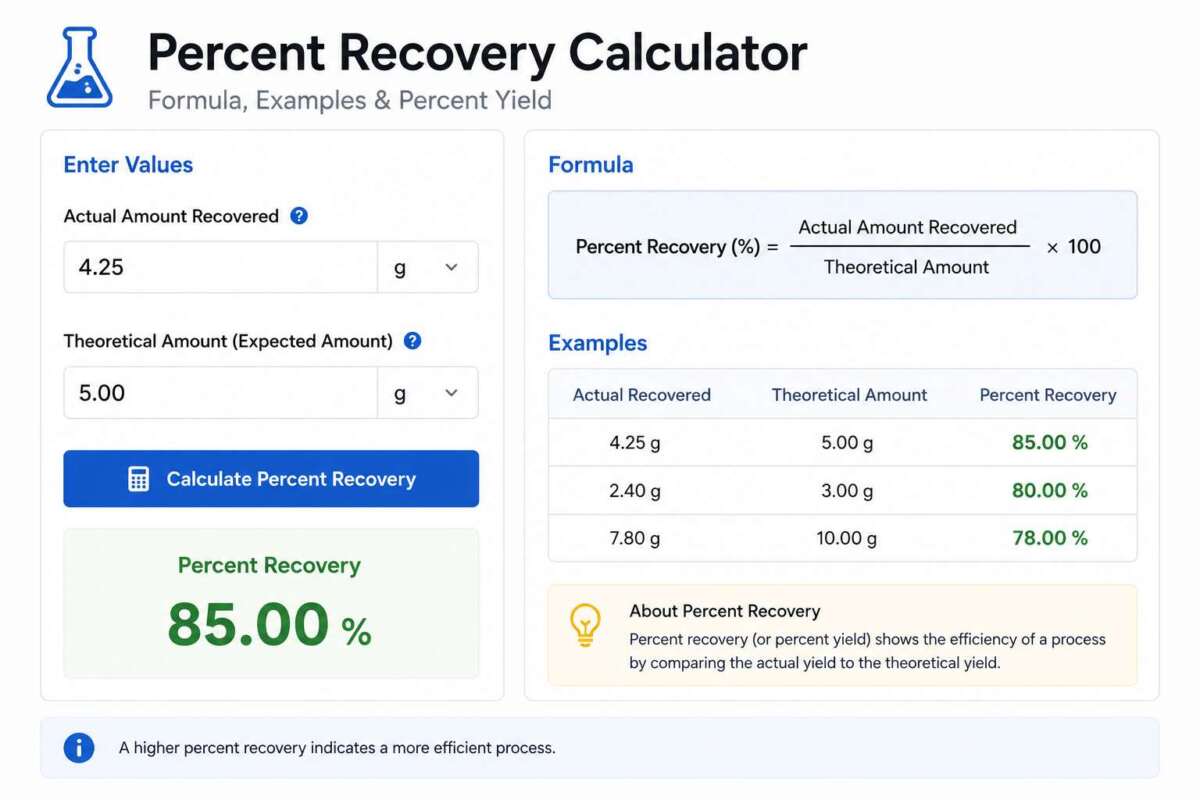
The Percent Recovery Calculator shows you exactly how to calculate percent recovery for a lab purification or isolation procedure — recrystallization, extraction, filtration, distillation — and clears up the single most common point of confusion in undergraduate chemistry labs: percent recovery is not the same thing as percent yield, even though students constantly mix the two up on lab reports.
Use the Percent Recovery tab to calculate recovery from starting and recovered mass, the Percent Yield tab to calculate the related-but-different value for a chemical reaction, or the Multi-Step Recovery tab to find your overall recovery across several purification steps — instantly.
Table of Contents
- Percent Recovery Calculator (Free Tool)
- What Is Percent Recovery?
- The Percent Recovery Formula
- Percent Recovery vs. Percent Yield: What’s the Difference?
- What’s a “Good” Percent Recovery?
- Why Percent Recovery Can Exceed 100%
- Calculating Overall Recovery Across Multiple Steps
- Frequently Asked Questions
Percent Recovery Calculator
Select a tab below to calculate percent recovery, percent yield, or overall recovery across multiple purification steps.
What Is Percent Recovery?
Percent recovery measures how much of a substance you successfully isolated or purified compared to how much you started with, expressed as a percentage. It’s the standard way to evaluate the efficiency of a physical purification or isolation procedure — recrystallization, liquid-liquid extraction, filtration, distillation, chromatography — where you’re separating and recovering the same chemical substance you began with, not creating a new one through a chemical reaction.
Every real-world purification loses some material along the way — to transfer losses (product stuck to glassware), solubility losses (some product staying dissolved in the mother liquor during recrystallization), incomplete extraction, or evaporation — which is exactly why percent recovery is almost always below 100%, and why reporting it accurately is a standard part of any lab write-up involving a purification step.
The Percent Recovery Formula
Percent Recovery (%) = (Recovered Mass ÷ Starting Mass) × 100
For example, if you start a recrystallization with 2.50 g of crude product and recover 2.05 g of purified crystals: percent recovery = (2.05 ÷ 2.50) × 100 = 82.0%. Both masses need to be in the same unit (typically grams) and should represent the same substance — comparing a crude starting mass (which may include impurities) against a purified recovered mass is standard and expected, since the whole point of the procedure is removing those impurities.
Percent Recovery vs. Percent Yield: What’s the Difference?
These two terms get mixed up constantly, but they answer genuinely different questions:
- Percent recovery applies to purification/isolation — no chemical reaction occurs. You start with a known mass of a substance and end with a purified/isolated mass of that same substance. Formula: recovered mass ÷ starting mass × 100.
- Percent yield applies to chemical reactions/synthesis — a new substance is created. You compare the actual mass of product obtained to the theoretical maximum mass calculated from reaction stoichiometry (moles of limiting reagent × molar mass of product, adjusted for the reaction’s mole ratio). Formula: actual yield ÷ theoretical yield × 100.
The practical test: did a chemical reaction happen, creating a new compound? Use percent yield, and calculate a theoretical yield from stoichiometry first (the Percent Yield tab above handles this). Did you simply separate, purify, or isolate a substance that already existed? Use percent recovery, comparing starting and recovered mass of the same compound directly.
What’s a “Good” Percent Recovery?
- 90-100%: Excellent — typical of a well-executed filtration or simple isolation with minimal transfer loss.
- 70-90%: Good — a common, solid result for a standard recrystallization or extraction in an undergraduate lab setting.
- 50-70%: Moderate — acceptable for a more demanding purification (removing a stubborn impurity, or a compound with significant solubility in the recrystallization solvent even when cold), but worth reviewing technique.
- Below 50%: Poor — usually indicates a technique issue (using too much solvent in recrystallization, incomplete extraction, significant transfer losses) worth troubleshooting before repeating.
What counts as “acceptable” varies by procedure and context — a challenging multi-step natural product isolation might celebrate 40% recovery, while a simple filtration should easily clear 90%. Check your specific lab’s expectations or your course’s grading rubric rather than treating these ranges as universal rules.
Why Percent Recovery Can Exceed 100%
A percent recovery above 100% is a red flag, not a triumph — it means the “recovered” mass is measuring more than just your pure target substance. The most common causes:
- Residual solvent: Crystals that weren’t fully dried still retain solvent mass, inflating the measured weight.
- Absorbed moisture: Hygroscopic compounds can pick up water from the air between drying and weighing.
- Unremoved impurities: If the purification didn’t fully separate a co-crystallizing or co-precipitating impurity, that extra mass counts toward your “recovered” weight without being your actual target compound.
- Measurement or calculation error: A miscalibrated balance, a transcription mistake, or weighing the container along with the product are all mundane but common culprits.
If your percent recovery comes out above 100%, the right response is almost always to re-dry the sample and re-weigh, not to report a value above 100% as if it were a valid result.
Calculating Overall Recovery Across Multiple Steps
Many real purification procedures involve multiple sequential steps — an extraction followed by a recrystallization, for instance. Overall recovery across a multi-step process is the product of each individual step’s recovery fraction, not their average or sum:
Overall Recovery (%) = Step 1 Recovery × Step 2 Recovery × Step 3 Recovery × … (each expressed as a decimal, then × 100)
For example, two steps each recovering a respectable 85%: overall recovery = 0.85 × 0.85 × 100 = 72.25% — noticeably lower than either individual step, simply because losses compound. This is exactly why chemists designing multi-step syntheses or purifications pay close attention to minimizing the number of steps and maximizing recovery at each one, since the compounding effect punishes long sequences even when every individual step looks reasonably efficient.
Frequently Asked Questions
What is the formula for percent recovery?
Percent Recovery = (Recovered Mass ÷ Starting Mass) × 100. Both masses should be in the same unit and represent the same substance before and after a purification or isolation procedure.
Is percent recovery the same as percent yield?
No. Percent recovery compares recovered mass to starting mass of the same substance in a purification procedure (no reaction occurs). Percent yield compares actual product mass to a theoretical yield calculated from reaction stoichiometry, and applies specifically to chemical synthesis reactions where a new compound is formed.
Why is my percent recovery over 100%?
Almost always because the recovered material isn’t fully pure — residual solvent, absorbed moisture, or an unremoved impurity is adding extra mass beyond your actual target compound. Re-dry and re-weigh the sample rather than reporting a result above 100%.
What’s a good percent recovery for a recrystallization?
70-90% is a common, solid result for a typical undergraduate-level recrystallization. Recoveries in the 50-70% range are still generally acceptable, especially for compounds with meaningful solubility in the recrystallization solvent even when cold; recoveries below 50% usually point to a technique issue worth reviewing (often using too much solvent).
How do I calculate recovery across a multi-step procedure?
Multiply each step’s recovery fraction together, then convert to a percentage — don’t average the individual step percentages, since that overstates the true overall recovery. Two 85% steps in sequence produce an overall recovery of about 72%, not 85%.
As an Amazon Associate, We earn from qualifying purchases. When you purchase a product through Amazon links on pulsefitguide.com, we may earn a small commission at no extra cost to you. This helps support the site and keep our content free.
