


Important: This tool is for general reference only and is not a substitute for medical advice. Newborn weight loss and feeding concerns can change quickly in the first week of life. Contact your pediatrician, midwife, or lactation consultant promptly with any concerns — do not wait if something feels wrong.
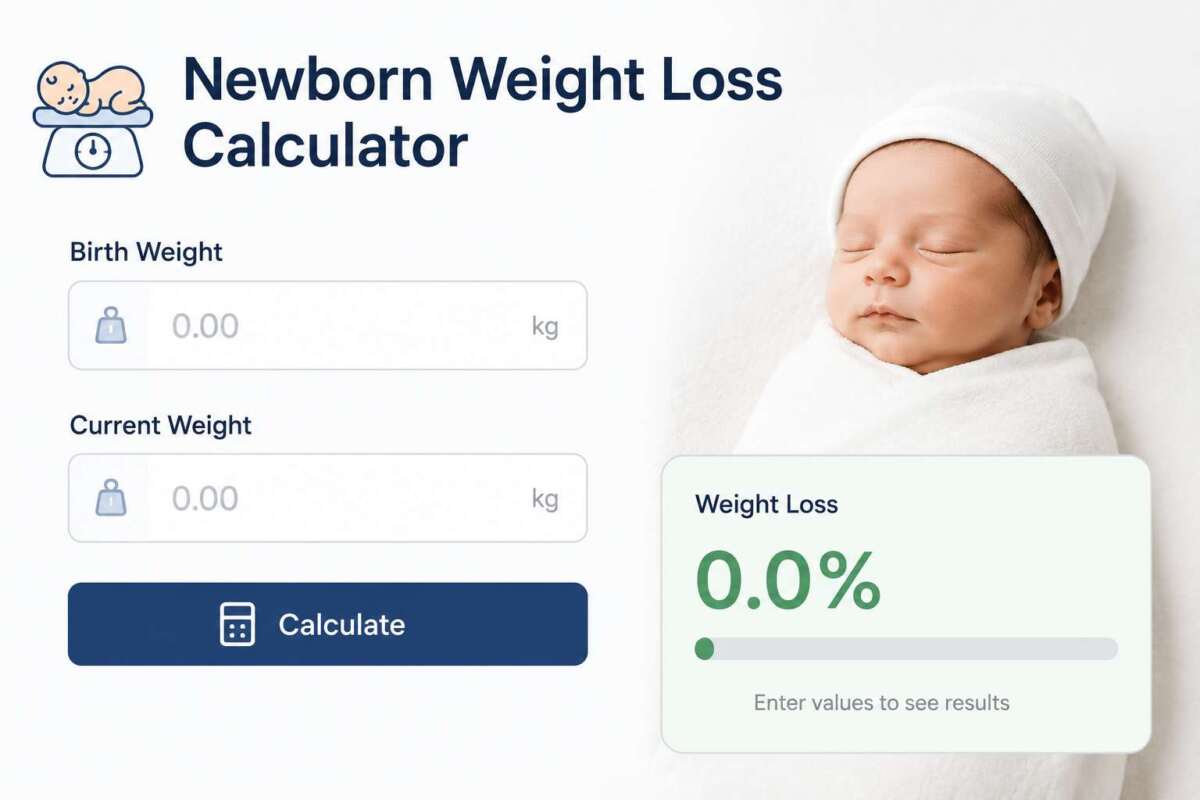
The Newborn Weight Loss Calculator is built specifically for the critical first week after birth. Use the Daily Weight Tracker tab to log weight loss percentage day by day, the Diaper Output Check tab to compare wet and dirty diaper counts against typical day-of-life expectations, or the Warning Signs Checklist tab to screen for symptoms that warrant contacting your care provider.
Table of Contents
- Newborn Weight Loss Calculator
- Why the First Week Matters Most
- Diaper Output as a Feeding Indicator
- Weight Loss Thresholds Explained
- Warning Signs — When to Call Your Provider
- Frequently Asked Questions
Newborn Weight Loss Calculator
Select a tab below. Leave any day’s weight at 0 to skip it if you don’t have that measurement.
| Day | Weight | Change from Birth | Status |
|---|
Why the First Week Matters Most
Nearly all of a newborn’s expected weight loss happens in the first 3-5 days of life, with most babies reaching their lowest weight around day 3 or 4 before trending back upward as feeding becomes established. This is why the first week gets so much attention from hospitals, midwives, and pediatricians — it’s a short window where feeding problems, if present, are both most likely to show up and most correctable with early support like lactation consulting or feeding adjustments.
Diaper Output as a Feeding Indicator
Because newborns can’t be weighed every few hours at home, diaper output is one of the most practical day-to-day indicators of adequate feeding between weight checks. A commonly cited general pattern is one wet diaper on day 1, two on day 2, and so on through roughly day 5-6, after which most babies settle into six or more wet diapers a day for the remainder of infancy. Stool patterns shift too — from the dark, tarry meconium of the first day or two toward looser, yellow, seedy stools (more frequent in breastfed babies) as feeding becomes established.
Weight Loss Thresholds Explained
- Under 7% loss: Generally considered within the common range for most newborns.
- 7-10% loss: Often prompts a closer feeding evaluation — common in breastfed babies still establishing milk supply, but worth monitoring.
- Over 10% loss: Commonly prompts a more thorough clinical check for dehydration, feeding effectiveness, or other underlying causes.
The trend matters as much as any single percentage — a baby who is still losing weight past day 4-5 without turning the corner is generally a bigger concern than a baby who hit a slightly higher percentage on day 3 but is clearly trending back up by day 5.
Warning Signs — When to Call Your Provider
Beyond the weight percentage itself, a cluster of other signs matters just as much — sometimes more. Contact your pediatrician, midwife, or lactation consultant promptly if you notice reduced wet/dirty diaper output for the baby’s age, unusual sleepiness or difficulty waking for feeds, a weak or absent cry, poor latch, new or worsening jaundice, fever or low temperature, or any signs of dehydration such as a dry mouth or sunken soft spot. Trust your instincts — it is always reasonable to call with a concern, even if it turns out to be nothing.
Frequently Asked Questions
When does newborn weight loss usually stop and reverse?
Most babies reach their lowest weight around day 3 or 4 of life and begin gaining from that point onward as feeding becomes fully established, typically regaining birth weight by around 10-14 days.
My baby’s weight loss percentage looks fine, but diaper output seems low — should I worry?
It’s worth mentioning to your pediatrician regardless — diaper output and weight don’t always move in perfect lockstep day to day, and a consistently low diaper count is itself a meaningful feeding indicator even if the most recent weight check looked reassuring.
Is it normal for weight loss percentage to go up a little before it goes down?
Yes, this is the expected pattern for most babies through roughly day 3-4 — weight loss typically continues (the percentage rises) before turning around, so a slightly higher percentage on day 2 or 3 than day 1 is usually not, by itself, cause for alarm as long as it isn’t crossing key thresholds or continuing well past day 4-5.
Can this checklist tell me if my baby is dehydrated?
No — it can help you notice patterns worth raising with a provider, but only a clinical exam can actually assess hydration status. If you’re ever genuinely worried your baby may be dehydrated, contact your provider or seek care promptly rather than relying on a checklist to decide.
As an Amazon Associate, We earn from qualifying purchases. When you purchase a product through Amazon links on pulsefitguide.com, we may earn a small commission at no extra cost to you. This helps support the site and keep our content free.
