


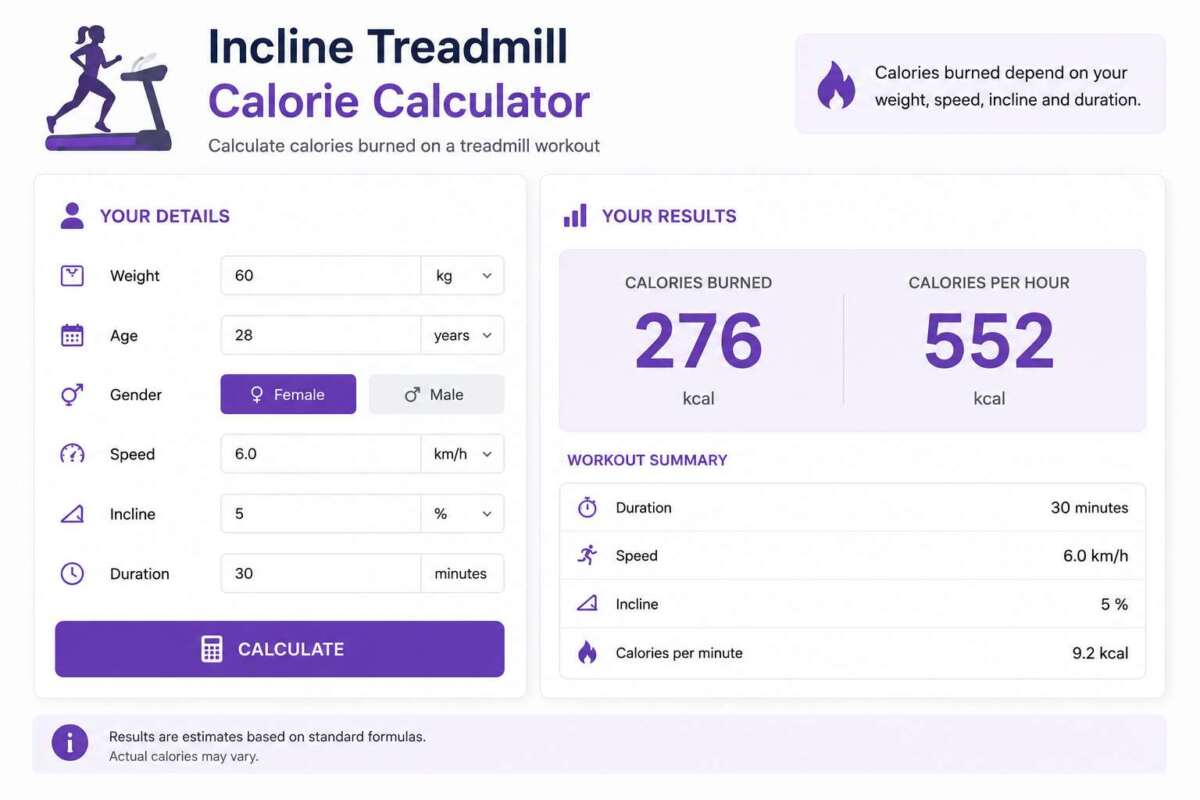
The Incline Treadmill Calorie Calculator estimates calories burned walking or running on an incline using the ACSM (American College of Sports Medicine) metabolic equations — the standard exercise physiology formulas that account for how speed and grade combine to raise energy cost, not just a flat MET lookup table.
Use the Walking on Incline tab for typical walking speeds, the Running on Incline tab for jogging/running speeds, or the Incline Boost Comparison tab to see exactly how much extra you burn at your incline versus a flat 0% grade at the same speed.
Table of Contents
- Incline Treadmill Calorie Calculator
- How Incline Affects Calorie Burn
- The ACSM Formula Explained
- Walking vs. Running Equation — Which Applies to You?
- Tips to Maximize Incline Calorie Burn
- Limitations
- Frequently Asked Questions
Incline Treadmill Calorie Calculator
Select a tab below. Speeds roughly under 5 mph generally fit the walking equation best; faster paces fit the running equation best — see the guidance section below if you’re unsure which to use.
How Incline Affects Calorie Burn
Walking or running on an incline adds a vertical-work component on top of the normal horizontal movement cost — your body has to lift its own weight upward with every step, not just move it forward. This extra vertical work scales with both your speed and the steepness of the grade, which is why a 5% incline at a brisk pace can burn meaningfully more calories than the same pace on flat ground, without needing to move any faster.
The ACSM Formula Explained
This calculator uses the American College of Sports Medicine’s standard metabolic equations, which estimate oxygen consumption (VO₂) from speed and grade, then convert that to calories:
- Walking VO₂ (mL/kg/min) = 0.1 × speed + 1.8 × speed × grade + 3.5
- Running VO₂ (mL/kg/min) = 0.2 × speed + 0.9 × speed × grade + 3.5
Where speed is in meters per minute and grade is the incline expressed as a decimal (5% = 0.05). VO₂ is then converted to calories using the standard approximation of 5 kilocalories burned per liter of oxygen consumed — a widely used conversion factor in exercise physiology.
Walking vs. Running Equation — Which Applies to You?
The walking equation is best validated for speeds roughly between 1.9 and 4.5 mph, while the running equation is best validated for speeds of roughly 5 mph and above — the two equations weigh speed and grade slightly differently to reflect how walking and running gaits use energy differently, especially on an incline. If your pace falls in the gap between about 4.5 and 5 mph (a fast walk or slow jog), either estimate is a reasonable approximation, but actual energy cost in that transition zone varies more between individuals than at clearly walking or clearly running paces.
Tips to Maximize Incline Calorie Burn
- Increase incline before increasing speed if your goal is calorie burn without added joint impact — incline raises energy cost with less pounding than running faster.
- Avoid holding the handrails — gripping the rails offloads real body weight from your legs, which meaningfully reduces the true calorie burn below what the display (or this calculator) estimates.
- Vary incline throughout a session (incline intervals) rather than a flat steady grade, which can increase total energy expenditure and reduce monotony.
- Keep an upright posture — leaning heavily on the console or hunching forward reduces the effective work your legs and core are doing against the incline.
Limitations
The ACSM equations are population-average formulas — actual calorie burn varies with individual fitness level, running/walking economy, muscle mass, and even stride technique. They also don’t account for handrail use (which reduces true effort below the display), wind resistance (irrelevant on a treadmill but relevant if comparing to outdoor incline walking), or non-treadmill terrain like uneven trails. Treat results as a solid estimate for comparison and tracking purposes, not a precise clinical measurement.
Frequently Asked Questions
Does a treadmill’s own calorie display use this same formula?
Many treadmill consoles use some variation of the ACSM equations or a similar metabolic formula, though exact implementations vary by manufacturer and aren’t always published. Differences in assumed weight accuracy, incline calibration, and rounding can cause a console’s number to differ somewhat from this calculator’s estimate.
Why does holding the handrails lower my actual calorie burn?
Gripping the handrails transfers some of your body weight support to your arms and the machine frame, meaning your legs and cardiovascular system are doing less actual work than the speed/incline/weight inputs alone would suggest — which is why fitness professionals generally recommend against holding on unless needed for safety.
Is a higher incline always better for calorie burn than higher speed?
Not universally — both raise calorie burn, and which is more effective depends on the specific speed/incline combination. Incline tends to raise calorie burn with comparatively less joint impact than increasing speed into a run, which is a common reason people favor incline walking as a lower-impact way to increase intensity.
Why does the calculator ask whether I’m walking or running instead of just using speed?
Walking and running are biomechanically different gaits with different energy cost curves, especially as incline increases — using the matching equation for your actual gait produces a more accurate estimate than applying a single formula to both.
As an Amazon Associate, We earn from qualifying purchases. When you purchase a product through Amazon links on pulsefitguide.com, we may earn a small commission at no extra cost to you. This helps support the site and keep our content free.
