


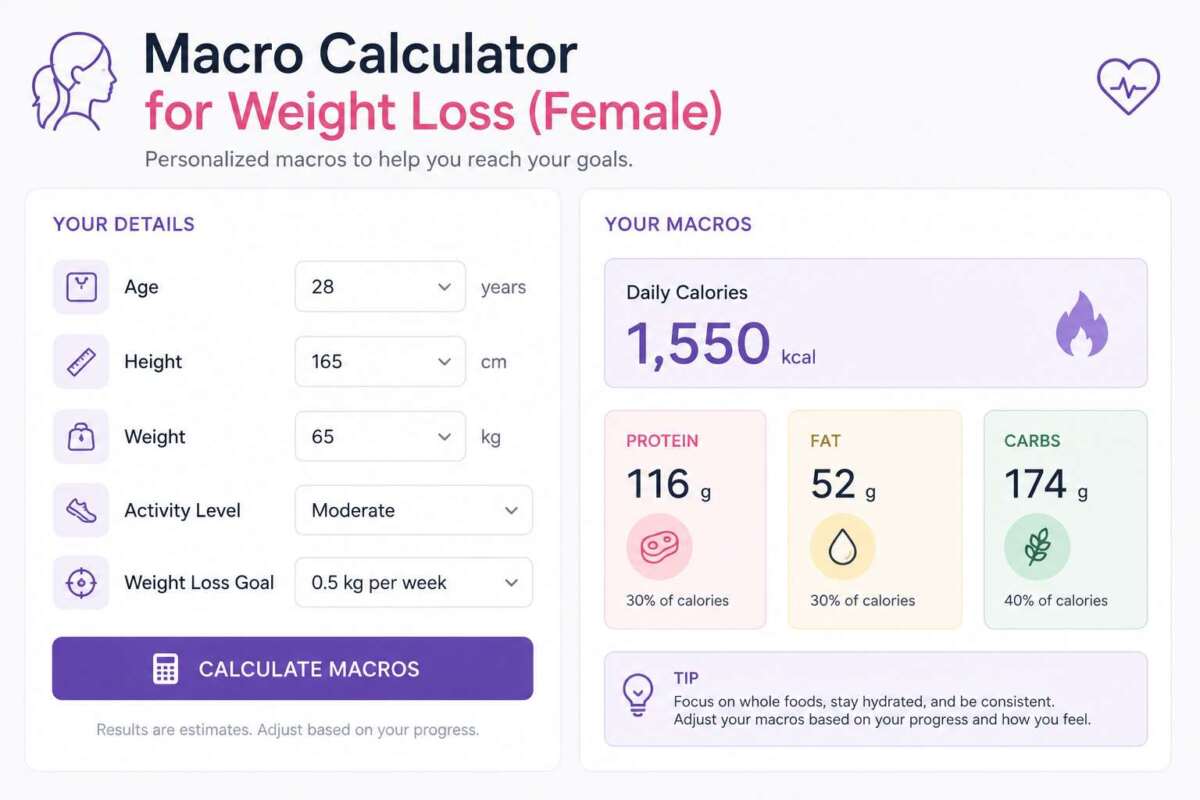
The Macro Calculator for Weight Loss (Female) calculates a calorie target and protein, carb, and fat breakdown tailored to women’s weight loss goals — with particular attention to protein intake, which is especially important for preserving lean muscle mass during a calorie deficit.
Use the Macro Calculator tab for a full TDEE-based calorie and macro breakdown, the Protein Target tab to check your protein intake against body-weight-based recommendations, or the Macro Split Comparison tab to see how Balanced, Higher-Protein, and Lower-Carb approaches divide up the same calorie target.
Table of Contents
- Macro Calculator for Weight Loss
- Why Protein Matters More for Women in a Deficit
- The Formulas Explained
- Choosing a Macro Split
- Choosing a Deficit Size
- Tips for Hitting Your Macros
- Frequently Asked Questions
Macro Calculator for Weight Loss
Select a tab below. Calculations use the Mifflin-St Jeor equation for resting metabolic rate, adjusted for activity level and a chosen deficit size.
| Style | Protein (g) | Carbs (g) | Fat (g) |
|---|---|---|---|
| Balanced | — | — | — |
| Higher Protein | — | — | — |
| Lower Carb | — | — | — |
Why Protein Matters More for Women in a Deficit
Any calorie deficit — the basis of weight loss — puts the body at risk of losing lean muscle mass alongside fat, not just fat alone. Adequate protein intake, combined with resistance training, helps signal the body to preserve muscle tissue while still losing fat. This matters for everyone, but is often highlighted specifically for women because women generally have a lower baseline muscle mass percentage than men and may be more prone to under-eating protein on lower overall calorie budgets if macros aren’t planned deliberately.
The Formulas Explained
Resting metabolic rate (Mifflin-St Jeor, women): BMR = 10 × weight(kg) + 6.25 × height(cm) − 5 × age − 161
Maintenance calories (TDEE): BMR × activity multiplier, ranging from 1.2 (sedentary) to 1.725 (very active).
Calorie target: TDEE reduced by your selected deficit percentage (10%, 20%, or 25% below maintenance).
Macro grams from calories: Protein and carbohydrate each provide 4 calories per gram; fat provides 9 calories per gram. Grams = (calorie target × macro percentage) ÷ calories per gram for that macro.
Choosing a Macro Split
- Balanced (30/40/30): A moderate, flexible starting point that doesn’t require avoiding any major food group.
- Higher Protein (40/30/30): Popular for weight loss specifically — higher protein tends to increase satiety (feeling full) and better supports muscle retention during a deficit.
- Lower Carb (35/20/45): Reduces carbohydrate intake in favor of fat while keeping protein high; some people find this approach easier for appetite control, though it isn’t inherently superior for fat loss compared to other splits at matched calories and protein.
There’s no single “correct” macro split for weight loss — total calorie deficit is what drives fat loss, while the macro split mainly affects satiety, muscle preservation, and how sustainable the plan feels day to day. Choosing a split you can realistically stick to consistently generally matters more than optimizing the exact ratio.
Choosing a Deficit Size
- Mild (10% below maintenance): Slower, more sustainable weight loss with less impact on energy, mood, and training performance — often better tolerated long-term.
- Moderate (20% below maintenance): A common default for steady, noticeable weight loss without an extreme calorie cut.
- Aggressive (25% below maintenance): Faster weight loss, but harder to sustain and carries a higher risk of muscle loss, fatigue, and rebound overeating if not carefully managed alongside adequate protein and resistance training.
Very low calorie targets (particularly under roughly 1,200 calories/day for most adult women without medical supervision) are generally discouraged, since they make it difficult to meet essential nutrient needs. If your calculated target falls very low relative to your activity level, consider a milder deficit or speak with a healthcare provider or registered dietitian.
Tips for Hitting Your Macros
- Prioritize protein first when planning meals — it’s the macro most people fall short on and the one most linked to preserving muscle and controlling appetite during a deficit.
- Use a food tracking app for the first few weeks to build an accurate sense of portion sizes — most people underestimate how much they’re actually eating without tracking.
- Don’t chase exact numbers every single day — hitting your macros within a reasonable range consistently matters more than perfect precision on any one day.
- Pair adequate protein with resistance training if preserving muscle and body composition (not just the number on the scale) is a priority.
Frequently Asked Questions
Why do macro recommendations differ for women versus men?
The underlying formulas (BMR, calories-per-gram) are the same for everyone — what differs is that women’s Mifflin-St Jeor calculation uses a different constant reflecting typically lower average lean body mass, and total calorie needs tend to be lower on average, which makes hitting adequate protein within a smaller calorie budget more of a deliberate planning consideration.
Do I need to hit my carb and fat targets exactly, or just protein and calories?
Protein and total calories are generally considered the two most important numbers for weight loss and muscle preservation. Carb and fat can typically flex somewhat within your remaining calorie budget based on personal preference, as long as fat intake stays high enough to support hormone health (commonly cited general guidance suggests not going below roughly 20% of calories from fat).
Is a higher protein target always better for weight loss?
More protein generally supports satiety and muscle preservation up to a point, but there’s a practical ceiling of usefulness, and drastically overshooting protein at the expense of adequate carbs and fat isn’t necessarily an advantage. The commonly cited 0.7-1.0 g/lb body weight range covers the level most research and coaching guidance associates with meaningful benefit for most people in a deficit.
Should I recalculate my macros as I lose weight?
Yes — as body weight decreases, maintenance calories (TDEE) typically decrease too, so recalculating every several weeks or after a meaningful weight change helps keep your calorie target and macros aligned with your current body rather than your starting point.
As an Amazon Associate, We earn from qualifying purchases. When you purchase a product through Amazon links on pulsefitguide.com, we may earn a small commission at no extra cost to you. This helps support the site and keep our content free.
