


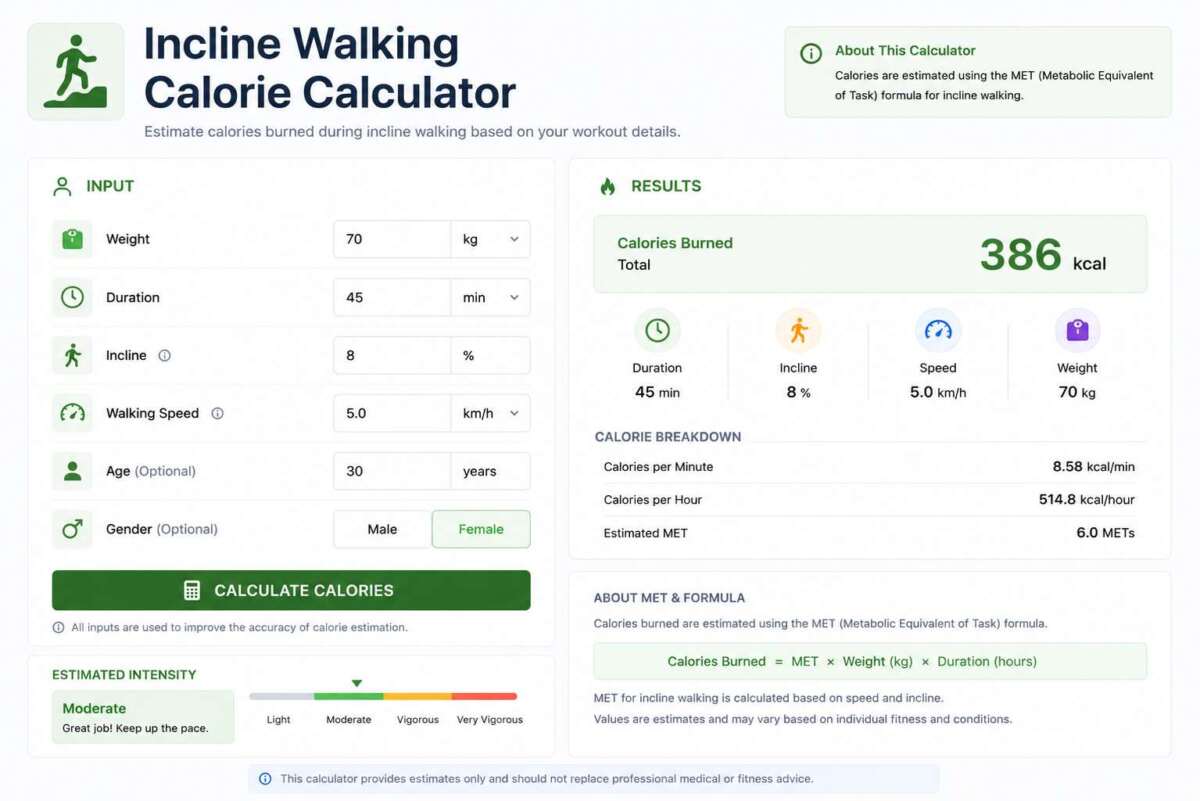
The Incline Walking Calorie Calculator estimates calories burned while walking on a grade — treadmill incline or an uphill outdoor route — using the ACSM walking metabolic equation. It accounts for your weight, walking speed, incline percentage, and duration, so it’s far more accurate than flat-ground calculators for incline treadmill workouts or hilly walks.
Use the Calorie Calculator tab to estimate calories burned for a single walk, the Flat vs. Incline tab to see exactly how much extra incline adds to your burn, or the Session Comparison tab to compare two different walks side by side — instantly.
Table of Contents
- Incline Walking Calorie Calculator
- Why Incline Changes Calorie Burn
- The Calorie Formula Explained
- How to Set Your Speed and Incline Accurately
- Effort Levels (MET Categories)
- Treadmill Incline vs. Outdoor Hills vs. Flat Walking
- Limitations of This Calculator
- Frequently Asked Questions
Incline Walking Calorie Calculator
Select a tab below to estimate calories for one walk, compare flat vs. incline burn, or compare two separate sessions. Enter your treadmill’s incline percentage directly, or use an outdoor grade estimate (rise ÷ distance × 100).
Why Incline Changes Calorie Burn
Walking on an incline forces your body to lift its own weight against gravity with every step, on top of the energy needed to simply move forward. That extra vertical work is why a slow, easy incline walk can burn calories comparable to a much faster flat walk or even a light jog, without the same impact on your joints. It’s also why incline calculators need a separate formula from flat-ground ones — a simple “calories per mile” flat-walking estimate significantly understates the cost of walking uphill.
The Calorie Formula Explained
This calculator uses the American College of Sports Medicine (ACSM) walking metabolic equation to estimate oxygen consumption (VO2), then converts that to calories:
VO2 (ml/kg/min) = 3.5 + 0.1 × speed(m/min) + 1.8 × speed(m/min) × grade
Speed is converted from mph to meters per minute, and grade is the incline expressed as a decimal (a 5% incline is 0.05). VO2 is then converted to calories per minute using the standard estimate of about 5 kcal burned per liter of oxygen consumed, and multiplied by your walk duration.
The equation has three parts: a resting baseline (3.5), a horizontal-movement component that scales with speed, and an incline component that scales with speed and grade together — which is why incline matters much more at a faster pace than a slow one.
How to Set Your Speed and Incline Accurately
- Treadmill speed: Use the display’s actual mph or km/h reading, not your guessed walking pace — treadmills report this directly and accurately.
- Treadmill incline: Use the display’s incline percentage directly; this is already the grade the formula expects.
- Outdoor grade: Estimate as (elevation gain ÷ horizontal distance) × 100. A route gaining 100 feet over a half-mile (2,640 feet) is roughly a 3.8% average grade — note that this is an average, and steeper sections will feel harder than the average number suggests.
- Outdoor speed: Use a GPS watch or phone app pace reading rather than estimating, since perceived pace is often inaccurate, especially uphill.
This calculator is most accurate for a walking pace between about 1.9 and 3.7 mph — outside that range, gait mechanics change (very slow strolling, or a fast pace that starts to resemble race-walking or jogging), and the walking-specific formula becomes less reliable.
Effort Levels (MET Categories)
METs (metabolic equivalents) describe exercise intensity as a multiple of resting energy use. Commonly used general activity intensity bands are:
- Light: Under 3 METs — a relaxed, easy-effort walk, typically flat or very low incline.
- Moderate: 3–6 METs — a brisk flat walk, or a slower walk at moderate incline; this range is the general target for most “moderate-intensity” activity guidelines.
- Vigorous: 6+ METs — a fast pace combined with meaningful incline, or a steep incline at almost any walking pace.
Because incline and speed multiply together in the formula, you can reach the moderate or vigorous range either by walking faster on flat ground, or by keeping a comfortable pace and adding incline — which is often easier on the joints for the same intensity.
Treadmill Incline vs. Outdoor Hills vs. Flat Walking
- Treadmill incline: Precise, controllable, and repeatable — the display gives an exact grade and speed, so this calculator’s estimates are typically most reliable here.
- Outdoor hills: More variable — grade usually changes throughout the route rather than staying constant, so any single grade number is an average, and actual burn will vary above and below the estimate as terrain changes.
- Flat walking: Lower calorie burn for the same speed and duration, but easier to sustain for longer periods and lower-impact, which can make total weekly calorie burn competitive with shorter incline sessions.
- Wind and surface: Neither treadmill nor outdoor calculations here account for wind resistance or soft/uneven terrain (sand, trail, snow), both of which increase actual effort beyond the formula’s estimate.
Limitations of This Calculator
This calculator estimates calories from a population-derived equation, not a direct measurement of your individual metabolism — actual calorie burn varies with fitness level, stride efficiency, muscle mass, and even how you hold the handrails (holding on reduces the effort of incline walking substantially, which this formula does not account for). It also assumes a steady pace and constant grade for the full duration, so it will be less accurate for interval-style incline workouts with varying speed or incline throughout. Treat results as a reasonable planning estimate rather than a precise clinical figure, and where possible cross-check against a heart-rate-based or metabolic cart estimate if available.
Frequently Asked Questions
How much does incline actually add to calorie burn?
It depends on speed, but incline adds up quickly — at a typical walking pace, each additional 1% of incline generally adds a meaningful percentage to your calorie burn, and the effect compounds with faster speeds since incline and speed multiply together in the formula. Use the Flat vs. Incline tab above to see the exact difference for your own weight, speed, and incline.
Does holding the treadmill handrails affect the estimate?
Yes, significantly. Holding the handrails — especially on a steep incline — transfers some of your body weight off your legs, which reduces actual effort well below what this calculator estimates. For the most accurate results, walk without holding on, or only using a light touch for balance.
Is incline walking better than running for calorie burn?
It depends on your goal. Running generally burns more calories per minute than incline walking at a comparable effort level, but incline walking is lower-impact and often more sustainable for longer durations, so total calorie burn over a full session can end up comparable — particularly for people who can walk at high incline for much longer than they could sustain a run.
Why does the same incline feel harder at a faster pace?
Because the incline component of the formula scales with speed — a given grade requires more added vertical work per minute the faster you’re moving over it, which is why combining incline with speed increases feels disproportionately harder than either change on its own.
Should I track calories or just track effort (METs)?
Both are useful for different purposes. Calorie totals are useful for weekly energy-balance goals, while MET-based effort level is a better guide for training intensity, since it reflects how hard the activity is regardless of how long you did it. Many people find it useful to keep effort in the moderate-to-vigorous range for cardiovascular benefit, and separately track total weekly calorie burn for weight goals.
As an Amazon Associate, We earn from qualifying purchases. When you purchase a product through Amazon links on pulsefitguide.com, we may earn a small commission at no extra cost to you. This helps support the site and keep our content free.
