


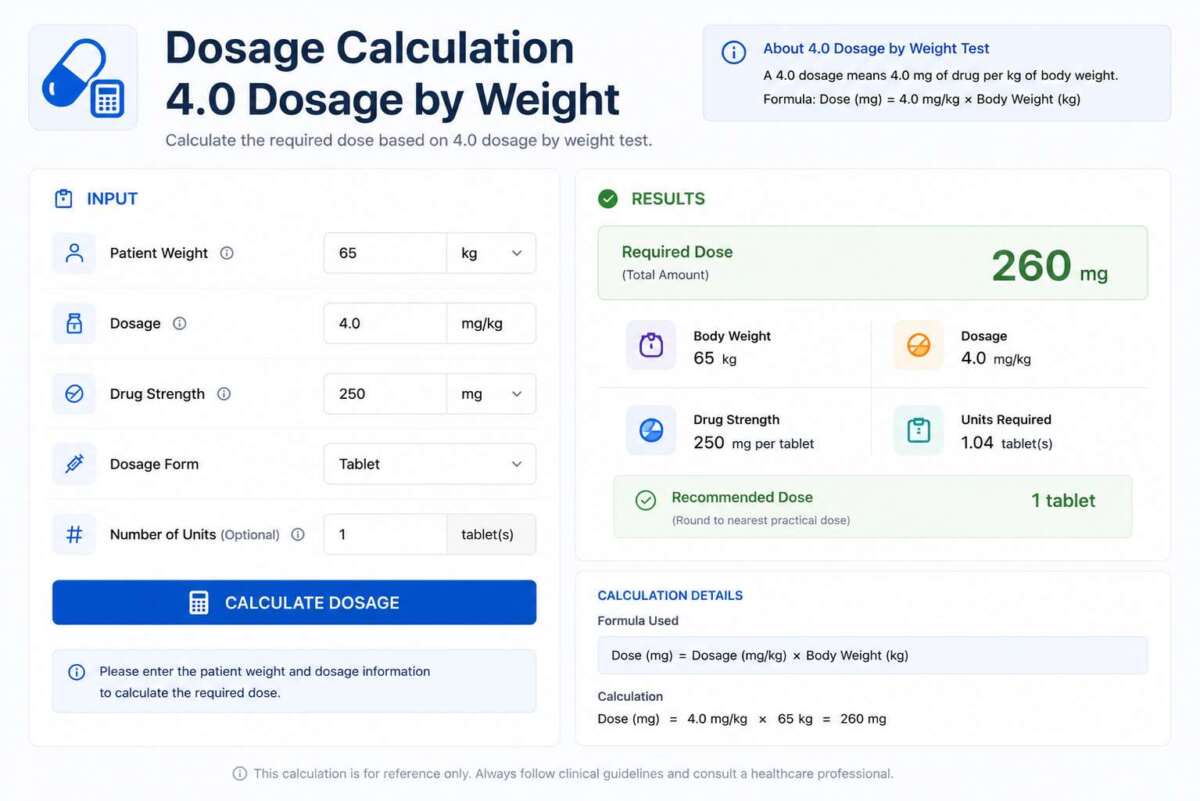
Important: This is a general math tool for educational purposes only. It performs the arithmetic you provide — it does not know any actual drug, dose range, or patient. It is not a substitute for a pharmacist, prescriber, drug reference, or clinical dosing software, and must never be used to determine an actual dose for a real person or animal without verification by a qualified professional against an authoritative drug reference.
The Dosage by Weight Calculator handles three common weight-based dosing calculations. Use the Dose by Weight tab to calculate a total dose from a weight and a mg/kg rate, the Split Into Doses tab to divide a total daily dose across multiple administrations per day, or the Dose to Volume tab to convert a dose in mg into a volume in mL based on a liquid concentration.
Table of Contents
- Dosage by Weight Calculator
- The Formulas Explained
- Why Dosing Is Often Based on Weight
- Limitations of This Tool
- Frequently Asked Questions
Dosage by Weight Calculator
Select a tab below. This tool performs only the math you request — always verify any real dosing decision against an authoritative reference or a qualified professional.
The Formulas Explained
- Dose by weight: Dose (mg) = Weight (kg) × Rate (mg/kg)
- Split into doses: Per-dose amount = Total daily dose ÷ Number of doses per day
- Dose to volume: Volume (mL) = Dose needed (mg) ÷ Concentration (mg) × Concentration (mL)
- Pound to kilogram conversion: Weight (kg) = Weight (lb) ÷ 2.20462
Why Dosing Is Often Based on Weight
Weight-based dosing scales an amount to body size on the reasoning that larger bodies generally distribute and process a substance across more tissue and blood volume than smaller ones. This is especially common in pediatric and veterinary contexts, where body weight varies enormously between individuals. In practice, real-world dosing also accounts for factors this simple calculation ignores — age, organ function, other medications, and the specific substance's own approved dosing range — which is why any real dosing decision needs a qualified professional and an authoritative reference, not just a weight-times-rate calculation.
Limitations of This Tool
This calculator does not contain any drug database, dose range, or safety limit — it multiplies and divides the exact numbers entered into it. It has no way to know if a rate you enter is appropriate, safe, or even a real dosing convention for any substance. It should be used only to check arithmetic for a rate and weight that a qualified source has already provided, never to originate a dosing decision from scratch.
Frequently Asked Questions
Can I use this calculator to determine an actual medication dose?
No. This tool performs only generic arithmetic on numbers you provide. It has no knowledge of any specific drug, its approved dosing range, contraindications, or safety limits. Any real dosing decision should come from a qualified prescriber, pharmacist, or authoritative drug reference — never from a generic weight-times-rate calculation alone.
Why convert weight from pounds to kilograms first?
Most weight-based dosing rates are expressed in mg per kilogram, since kilograms are the standard unit in clinical and scientific references. If a weight is recorded in pounds, converting to kilograms first (dividing by 2.20462) keeps the units consistent with the rate being used.
What's the difference between a "per dose" rate and a "per day" rate?
A per-dose rate gives the amount for a single administration directly. A per-day rate gives the total amount intended across an entire day, which then needs to be divided by the number of doses per day (using the Split Into Doses tab) to find the amount for each individual administration.
How is the volume calculation useful for liquid formulations?
Liquid formulations are often measured by volume (mL) rather than weight (mg) directly, since it's easier to draw up or measure a liquid volume than to weigh out a solid amount. If you know the desired dose in mg and the liquid's concentration (how many mg are in a given mL), this calculation converts between the two so the correct volume can be measured.
As an Amazon Associate, We earn from qualifying purchases. When you purchase a product through Amazon links on pulsefitguide.com, we may earn a small commission at no extra cost to you. This helps support the site and keep our content free.
