


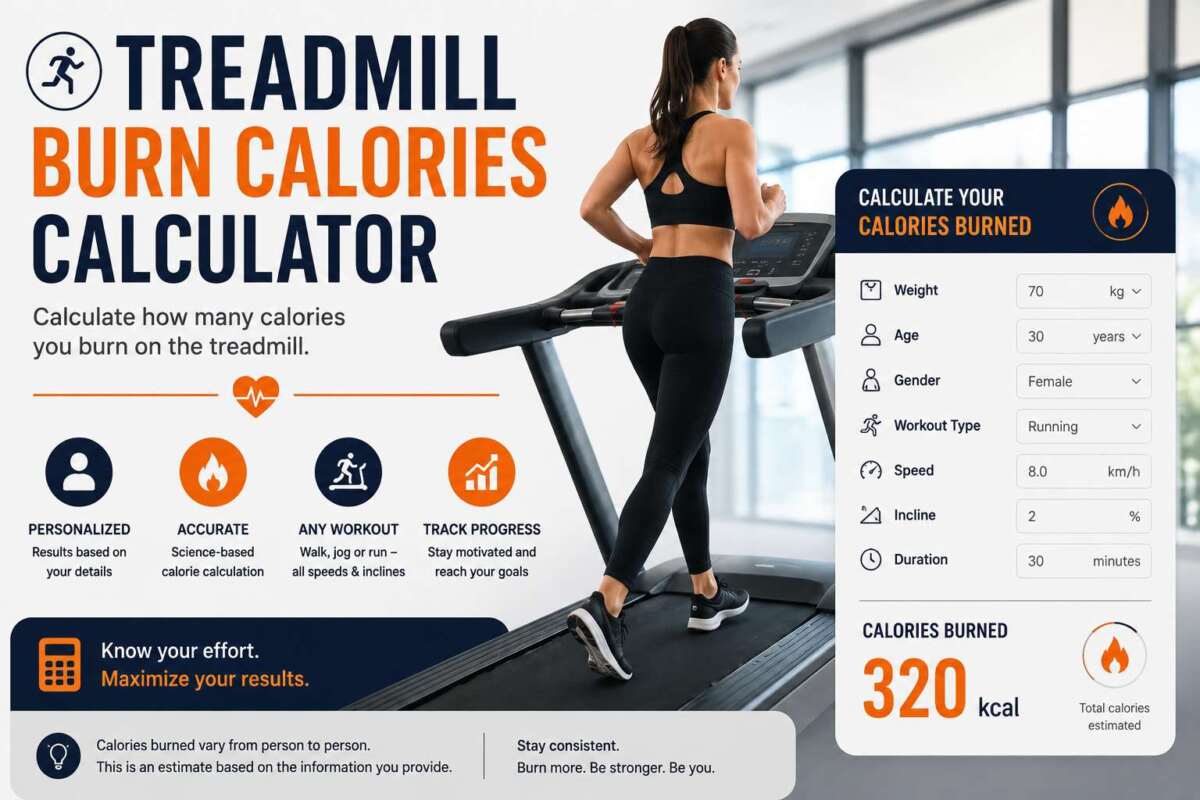
The Treadmill Burn Calories Calculator works the way most treadmill sessions actually get planned — around distance, time, and calorie goals, not just a single speed and incline entry. Use the Calories by Distance & Time tab to calculate burn from a completed or planned session, the Calorie Goal tab to find out how long or far you need to go to hit a target, or the Interval vs. Steady-State tab to see whether alternating fast and slow segments burns more than a constant pace.
Table of Contents
- Treadmill Burn Calories Calculator
- How This Calculator Works
- The Formulas Explained
- Why Intervals Can Burn More Calories
- Accuracy Notes
- Frequently Asked Questions
Treadmill Burn Calories Calculator
Select a tab below. Calculations use the ACSM metabolic equations at a flat 0% grade — for an incline-specific breakdown, see a dedicated incline treadmill calculator instead.
How This Calculator Works
Rather than requiring you to already know your treadmill speed and time separately, this calculator starts from the numbers most people actually have on hand after or before a session: total distance and time, a calorie goal, or a planned workout structure. Behind the scenes it still relies on the same underlying relationship between speed, body weight, and oxygen cost — it’s just organized around how treadmill sessions are typically planned and logged.
The Formulas Explained
All tabs use the ACSM metabolic equations at a flat 0% grade, automatically switching between the walking and running formula based on speed:
- Walking VO₂ (under 5 mph): 0.1 × speed + 3.5 (mL/kg/min)
- Running VO₂ (5 mph and above): 0.2 × speed + 3.5 (mL/kg/min)
VO₂ converts to calories using the standard approximation of 5 kilocalories burned per liter of oxygen consumed. The Distance & Time tab derives your average speed from distance ÷ time; the Calorie Goal tab solves the same relationship in reverse for time and distance; the Interval tab averages the per-minute calorie cost of the fast and slow phases across the total session time.
Why Intervals Can Burn More Calories
Calorie cost per minute rises faster than linearly with speed at higher intensities, so alternating between a genuinely fast segment and a genuinely slow recovery segment can produce a higher average calorie burn than holding a single moderate pace for the same total time — even though the “average speed” might look similar on paper. The size of this effect depends heavily on how much faster the fast segments actually are; alternating between two very similar speeds produces close to the same result as steady-state.
Accuracy Notes
These are population-average formulas — actual calorie burn varies with fitness level, running/walking economy, and individual physiology. Holding the handrails reduces true effort below what these calculations assume, since it offloads body weight support from your legs. The Interval tab assumes exactly equal time in fast and slow phases and does not model the extra oxygen consumption that can continue briefly after a high-intensity effort ends, so treat all results as reasonable estimates for planning and comparison rather than precise clinical measurements.
Frequently Asked Questions
Why does the Calories by Distance tab need both distance and time?
Calorie burn depends on speed (or pace), not distance alone — running 3 miles in 20 minutes burns considerably more than walking the same 3 miles in 60 minutes. Distance and time together let the calculator derive your actual speed and apply the correct formula.
Does this calculator account for incline?
No — this calculator assumes a flat 0% grade throughout. Adding incline increases calorie burn beyond what’s shown here; if incline is a key part of your workout, a dedicated incline treadmill calculator that factors in grade will give a more accurate estimate.
Is the Calorie Goal tab’s time estimate realistic for a real workout?
It reflects the pure calorie math at a constant speed, but doesn’t account for warm-up, cool-down, or fatigue-related pace changes over a long session — treat it as a planning baseline rather than an exact session plan, especially for longer durations or unfamiliar paces.
Should I always choose intervals over steady-state for more calorie burn?
Not necessarily — the calorie difference depends on how aggressive the fast/slow speed gap is, and steady-state sessions have their own well-established benefits for aerobic base building and recovery. Which approach is “better” depends on your goals, current fitness level, and how sustainable each style is for you consistently, not just the calorie total from a single session.
As an Amazon Associate, We earn from qualifying purchases. When you purchase a product through Amazon links on pulsefitguide.com, we may earn a small commission at no extra cost to you. This helps support the site and keep our content free.
