


Important: This tool is for educational and reference purposes only and is not a substitute for clinical judgment or medical advice. Free water deficit calculations are estimates based on population-average formulas — individual patient factors, ongoing losses, and clinical context all affect actual replacement needs. Always defer to your healthcare provider or institutional protocols for diagnosis and treatment decisions.
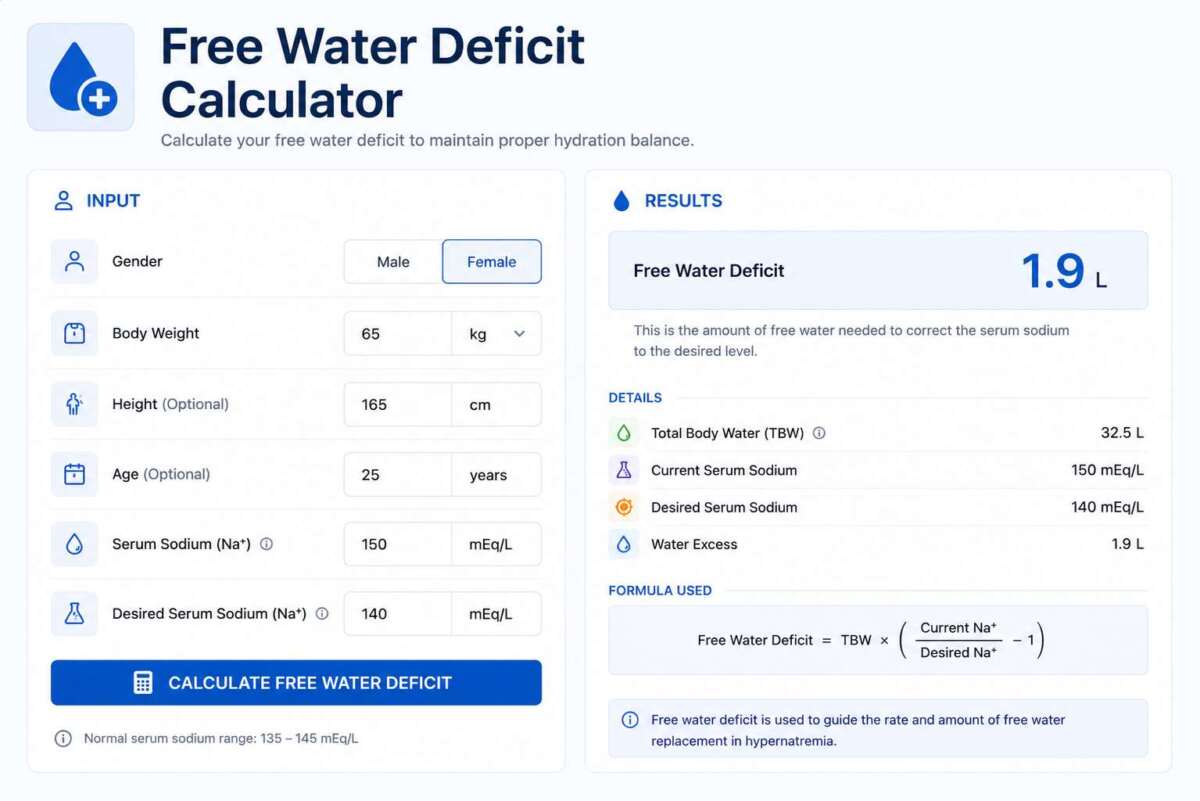
The Free Water Deficit Calculator estimates the volume of water needed to correct hypernatremia (elevated serum sodium) back to a normal target. Use the Water Deficit tab to calculate the deficit and a suggested replacement rate, or the Total Body Water tab to estimate TBW alone using the Watson equation.
Table of Contents
- Free Water Deficit Calculator
- What Is Free Water Deficit?
- The Free Water Deficit Formula Explained
- Total Body Water Reference
- Free Water Replacement Rate Guidelines
- Limitations and Clinical Considerations
- Frequently Asked Questions
Free Water Deficit Calculator
Select a tab below. All calculations use standard clinical formulas for free water deficit and total body water estimation.
What Is Free Water Deficit?
Free water deficit (FWD) is the estimated volume of pure, electrolyte-free water that is missing from the body, calculated from an elevated serum sodium (hypernatremia). When serum sodium rises above normal (~135-145 mEq/L), it generally indicates that water has been lost in excess of electrolytes — through insensible losses (sweating, respiration), inadequate fluid intake, diabetes insipidus, or osmotic diuresis. Correcting hypernatremia requires replacing this water deficit while also accounting for ongoing daily losses.
The Free Water Deficit Formula Explained
This calculator uses the Adrogue-Madias formula, the most widely cited clinical method:
FWD (L) = TBW x [ (Na_current / Na_target) – 1 ]
Where TBW (total body water) is estimated as a fraction of body weight: 60% for males, 50% for females, and approximately 45% for children or adults over 65. These fractions reflect average body composition — individuals with higher muscle mass will have higher TBW, while those with higher adipose tissue will have lower TBW relative to weight.
Total Body Water Reference
- Adult males: ~60% of body weight
- Adult females: ~50% of body weight
- Children / Elderly (>65): ~45% of body weight
- Watson equation (males): 2.447 – 0.09156 x age + 0.1074 x height(cm) + 0.3362 x weight(kg)
- Watson equation (females): -2.097 + 0.1069 x height(cm) + 0.2466 x weight(kg)
Free Water Replacement Rate Guidelines
A key principle in correcting hypernatremia is avoiding overly rapid sodium reduction, which can cause cerebral edema. Standard clinical guidance recommends:
- Maximum correction rate: No faster than 10-12 mEq/L per 24 hours (some sources cite 8-10 mEq/L/day for chronic hypernatremia)
- Acute hypernatremia (<24-48 hours): Faster correction may be tolerated
- Chronic or unknown duration: Slower correction over 48-72 hours is generally safer
- Serial monitoring: Serum sodium should be checked every 2-4 hours during active correction
- Ongoing losses: The calculated deficit does not include ongoing insensible losses (~500-1000 mL/day) or renal losses, which must be added to total fluid replacement
Limitations and Clinical Considerations
The free water deficit formula is a starting-point estimate, not a precise prescription. Several factors limit its accuracy and require individualized clinical assessment:
- TBW estimation error: The weight-fraction method assumes average body composition — obese, edematous, or very lean patients will have actual TBW that differs from the estimate
- Ongoing losses: Active diabetes insipidus, continued sweating, diarrhea, or high urine output will continue to generate new deficit during replacement
- Fluid type: D5W provides free water directly; hypotonic saline provides partial free water with some sodium; these affect how calculated volumes translate to infusion volumes
- Renal function: Impaired renal water handling affects the rate of sodium correction and may necessitate more frequent re-assessment
- Comorbidities: Heart failure, cirrhosis, and other conditions affect fluid distribution and tolerance
Frequently Asked Questions
What is a normal serum sodium level?
Normal serum sodium is typically 135-145 mEq/L. Values above 145 mEq/L are considered hypernatremia. Values between 146-149 mEq/L are often described as mild, 150-159 mEq/L as moderate, and 160 mEq/L or above as severe hypernatremia — though clinical severity also depends on the rate of onset, patient age, and symptoms.
Why does the target sodium matter?
The target sodium determines how much correction is planned in a given session. While 140 mEq/L is a common default target, clinicians may choose a higher intermediate target (for example, 148 mEq/L after 24 hours) in severe or chronic hypernatremia to prevent overly rapid correction. The calculator allows you to enter any clinically appropriate target.
Does the free water deficit formula account for ongoing losses?
No. The Adrogue-Madias formula calculates only the existing deficit at one point in time. Total fluid replacement in practice must also include estimated ongoing insensible losses (roughly 500-1000 mL/day in afebrile adults, more with fever or sweating), measured urine output, and any other sources of water loss. Failing to account for ongoing losses is a common reason why sodium corrects more slowly than the formula predicts.
Which fluids are used to replace free water?
The choice of replacement fluid depends on the route and clinical situation. Oral water or nasogastric free water is the most efficient way to replace free water. Intravenously, D5W (5% dextrose in water) effectively provides free water (the dextrose is rapidly metabolized). Quarter-normal saline (0.225% NaCl) and half-normal saline (0.45% NaCl) provide partial free water along with electrolytes — their free water fraction must be accounted for when calculating infusion volumes. Normal saline (0.9% NaCl) does not contribute to free water replacement.
Why might the actual sodium correction differ from the calculated prediction?
Multiple factors affect the actual rate of sodium change: ongoing losses that exceed the estimated replacement, variable renal water handling, the sodium content of the replacement fluid, changes in patient fluid intake and output, and individual variation in TBW. This is why serial monitoring of serum sodium — typically every 2-4 hours during active correction — is essential rather than relying on a single calculated rate throughout the treatment period.
As an Amazon Associate, We earn from qualifying purchases. When you purchase a product through Amazon links on pulsefitguide.com, we may earn a small commission at no extra cost to you. This helps support the site and keep our content free.
