


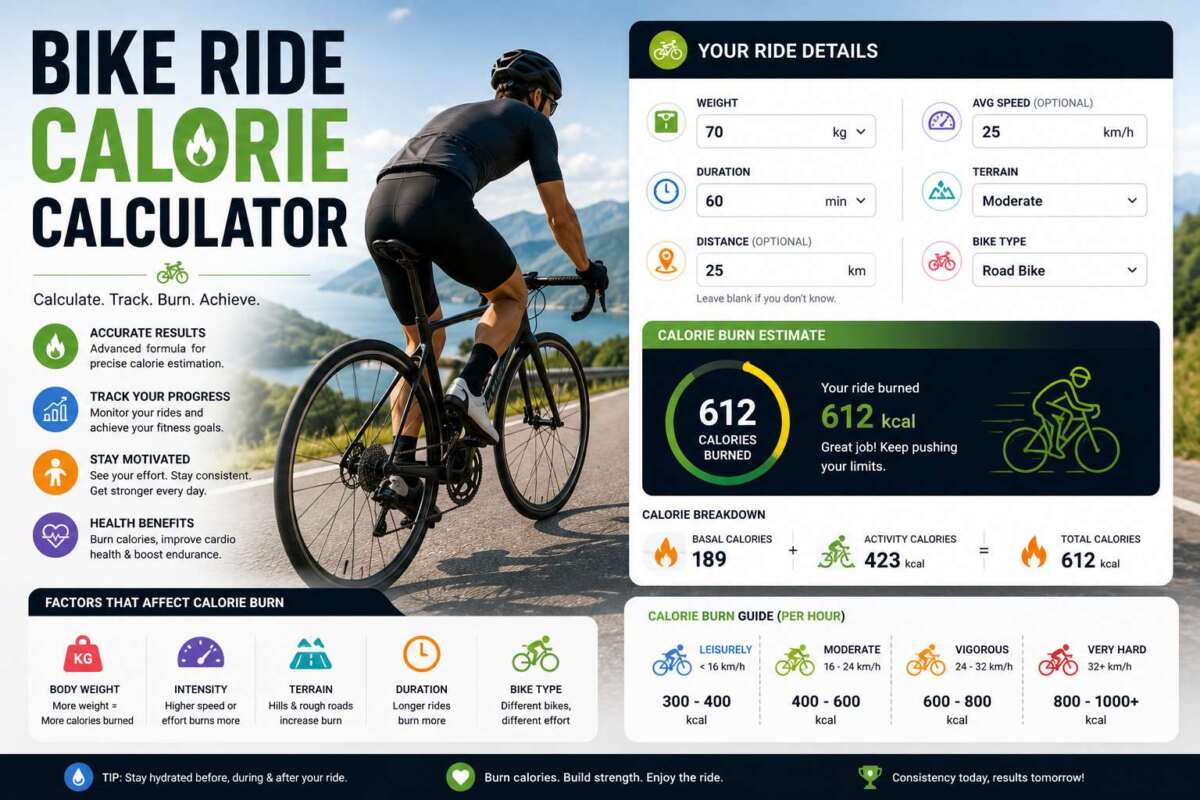
The Bike Ride Calorie Calculator covers the three ways cyclists actually estimate calorie burn — by average speed and distance, by average power output in watts for riders with a power meter or smart trainer, and by elevation gain for rides with real climbing. Use the By Speed & Distance tab for a standard MET-based estimate, the By Power (Watts) tab for a more precise estimate from actual power data, or the Elevation Gain Bonus tab to see how much extra climbing adds to a ride.
Table of Contents
- Bike Ride Calorie Calculator
- Speed-Based vs. Power-Based Estimates
- The Formulas Explained
- Why Elevation Gain Matters
- Accuracy Notes
- Frequently Asked Questions
Bike Ride Calorie Calculator
Select a tab below. If you have power meter data from your ride, the Power (Watts) tab will generally give a more precise estimate than the speed-based tab.
Speed-Based vs. Power-Based Estimates
Speed-based calorie estimates use average speed as a proxy for effort, which works reasonably well on flat, calm-wind rides but can be thrown off by hills, headwinds, drafting, or aerodynamic position — two rides at the same average speed can involve very different actual physical effort. Power-based estimates measure your actual mechanical output directly in watts, making them far less sensitive to external conditions like wind or terrain, which is why they’re generally considered more accurate for riders who have a power meter or smart trainer available.
The Formulas Explained
Speed-based (MET method): Calories/minute = (MET × 3.5 × weight in kg) ÷ 200, with MET values increasing across standard speed brackets (under 10 mph, 10-11.9 mph, 12-13.9 mph, 14-15.9 mph, 16-18.9 mph, 19-21.9 mph, and 22+ mph).
Power-based (watts): Mechanical work (kJ) = Power (W) × time (seconds) ÷ 1000. Calories (kcal) = Work (kJ) ÷ Efficiency ÷ 4.184. At a typical ~24% gross efficiency, this produces the widely used cycling shortcut of “calories burned ≈ kilojoules of work done.”
Elevation gain bonus: Work against gravity (Joules) = mass (kg) × 9.81 m/s² × elevation gain (meters). This is converted to kcal and divided by the same ~24% efficiency figure used for the power-based method, since climbing is ultimately just another form of mechanical work performed by the same muscles.
Why Elevation Gain Matters
Riding uphill requires doing real physical work against gravity, on top of the usual work of overcoming rolling resistance and air drag — which is why two rides of identical distance can have meaningfully different calorie costs if one is flat and the other involves significant climbing. Speed alone doesn’t capture this well, since climbing naturally happens at a slower speed even though the effort (and calorie cost) is often higher than flat riding at the same speed. Adding a dedicated elevation gain calculation on top of a flat-terrain speed or power estimate gives a more complete picture for hilly routes.
Accuracy Notes
All three methods are estimates. MET-based speed values are population averages that don’t account for wind, drafting, aerodynamic position, or bike type. The power-based method is generally more accurate but still depends on the assumed efficiency figure, which varies somewhat between individual cyclists (typically cited in the 20-25% range for trained riders). The elevation calculation captures the physics of climbing but doesn’t separately account for the reduced air resistance typically experienced at the slower speeds climbing usually involves. Combine methods thoughtfully rather than stacking full independent estimates, and treat all results as reasonable planning and comparison figures rather than precise clinical measurements.
Frequently Asked Questions
Why does my bike computer’s calorie number differ from this calculator?
Different devices use different assumed efficiency figures, different MET tables (if not power-based), and sometimes proprietary adjustments — small differences in any of these compound into a visibly different final number, even for the same ride data.
Should I use the speed-based or power-based tab if I have a power meter?
Use the power-based tab — it measures your actual mechanical output directly rather than inferring effort from speed, making it less affected by wind, drafting, and terrain, and generally considered the more reliable method when accurate power data is available.
Why is cycling efficiency only around 24%, not higher?
Human muscles convert a limited fraction of metabolic energy into actual mechanical work, with the rest released as heat — this is a physiological limit common to muscular effort in general, not specific to cycling technique, and roughly 20-25% gross efficiency is well established in exercise physiology research for trained cyclists.
How do I avoid double-counting calories when combining flat and elevation estimates?
The Elevation Gain Bonus tab is meant to estimate only the extra climbing-specific work, added on top of a baseline flat-terrain estimate — if your speed or power data already reflects a hilly ride’s slower climbing pace, treat the elevation bonus as a rough supplement rather than a fully independent, stackable total, since some of the climbing effort is already partially reflected in a lower average speed or higher average power.
As an Amazon Associate, We earn from qualifying purchases. When you purchase a product through Amazon links on pulsefitguide.com, we may earn a small commission at no extra cost to you. This helps support the site and keep our content free.
