


Important: This tool is for educational and reference purposes only. It is not a substitute for clinical judgment. Actual ventilator settings must always be determined by a qualified physician or respiratory therapist based on the patient’s full clinical picture, not a calculator alone.
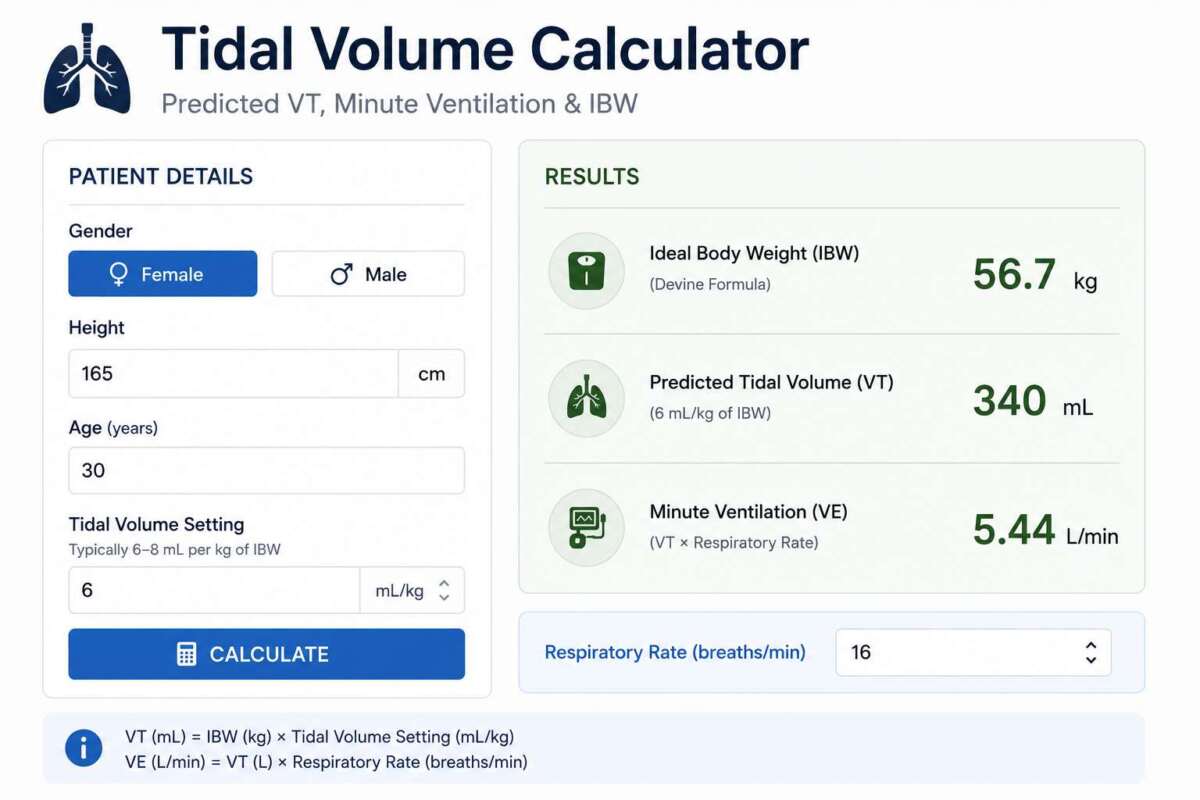
The Tidal Volume Calculator estimates predicted tidal volume using Ideal Body Weight (IBW) — the standard lung-protective ventilation approach, since lung size correlates with height and frame, not actual body weight. Use the Predicted Tidal Volume tab to calculate a target volume from height and sex, the Minute & Alveolar Ventilation tab to work out total and effective ventilation, or the Ventilator Safety Check tab to see whether a set tidal volume falls within the standard lung-protective mL/kg range.
Table of Contents
- Tidal Volume Calculator
- What Is Tidal Volume?
- Why Ideal Body Weight, Not Actual Weight?
- The Formulas Explained
- Lung-Protective Ventilation Ranges
- Limitations
- Frequently Asked Questions
Tidal Volume Calculator
Select a tab below. All calculations use Ideal Body Weight (IBW) via the Devine formula, the standard reference weight for tidal volume dosing in lung-protective ventilation.
What Is Tidal Volume?
Tidal volume (V_T) is the volume of air moved into or out of the lungs during a single normal breath. In spontaneous breathing, it’s a measured quantity — typically around 500 mL for a resting adult, or roughly 7 mL per kg of body weight. In mechanical ventilation, tidal volume becomes a value the clinician sets, and getting it right matters enormously: too high, and repeated overstretching of the alveoli can cause ventilator-induced lung injury; too low, and inadequate gas exchange or atelectasis can result.
Why Ideal Body Weight, Not Actual Weight?
Lung size correlates with height and skeletal frame, not with fat mass. Two patients of the same height but very different actual body weights (due to body fat, edema, or fluid status) have very similar lung volumes. Dosing tidal volume off actual body weight in a heavier patient can lead to dangerously large, lung-damaging breaths, which is why lung-protective ventilation protocols (such as the ARDSnet protocol) specify tidal volume per kilogram of Ideal Body Weight (IBW) rather than actual measured weight.
The Formulas Explained
Ideal Body Weight (Devine formula):
- Men: IBW (kg) = 50 + 2.3 × (height in inches − 60)
- Women: IBW (kg) = 45.5 + 2.3 × (height in inches − 60)
Predicted/Target Tidal Volume: Target V_T = mL/kg × IBW, most commonly dosed at 6 mL/kg IBW as a lung-protective default, within an accepted 4-8 mL/kg range depending on clinical circumstances.
Minute Ventilation: Minute Ventilation = Tidal Volume × Respiratory Rate — the total volume of air moved per minute.
Alveolar Ventilation: Alveolar Ventilation = (Tidal Volume − Dead Space) × Respiratory Rate — the portion of minute ventilation that actually reaches gas-exchanging alveoli, excluding air that only fills the conducting airways (anatomic dead space, commonly approximated as ~2.2 mL/kg IBW).
Lung-Protective Ventilation Ranges
Widely referenced lung-protective ventilation strategies (popularized by the ARDSnet trial) generally target 4-8 mL/kg of Ideal Body Weight, with 6 mL/kg as a common default starting point — lower volumes (closer to 4 mL/kg) are sometimes used in more severe cases, adjusted alongside plateau pressure monitoring (typically kept below roughly 30 cm H₂O) and other clinical parameters. These are general reference ranges from clinical literature, not a fixed rule for every patient or every ventilation scenario.
Limitations
This calculator performs reference arithmetic only — it does not account for plateau pressure, driving pressure, lung compliance, PEEP, oxygenation status, acid-base status, or the many other factors a clinician weighs when actually setting or adjusting ventilator parameters. Dead space estimates are population averages and can differ meaningfully from a specific patient’s measured dead space. This tool is meant to support understanding of the underlying calculations, not to generate or validate an actual ventilator order.
Frequently Asked Questions
Why is tidal volume calculated from height instead of actual weight?
Because lung capacity tracks with body frame (height), not fat mass or fluid weight. Using actual weight in a patient with excess body fat or fluid retention would overestimate appropriate lung volume and risk delivering breaths large enough to injure the lungs.
What’s the difference between tidal volume and minute ventilation?
Tidal volume is the amount of air moved in one single breath. Minute ventilation is the total air moved in one minute — tidal volume multiplied by respiratory rate. Two patients can have the same minute ventilation with very different combinations of tidal volume and rate (e.g., large slow breaths versus small fast breaths).
What is dead space and why does it matter?
Dead space is the portion of each breath that fills the airways (nose, throat, trachea, bronchi) without reaching the alveoli where gas exchange actually happens. Only the tidal volume minus dead space — the alveolar ventilation — contributes to oxygenation and CO₂ removal, which is why alveolar ventilation is often a more clinically meaningful number than minute ventilation alone.
Is 6 mL/kg always the right tidal volume setting?
No — 6 mL/kg IBW is a commonly used default and reference point in lung-protective ventilation literature, but the appropriate setting for any individual patient depends on their diagnosis, lung compliance, plateau pressure response, and overall clinical status, and must be determined by the treating clinical team.
As an Amazon Associate, We earn from qualifying purchases. When you purchase a product through Amazon links on pulsefitguide.com, we may earn a small commission at no extra cost to you. This helps support the site and keep our content free.
