


Important: Water fasting — consuming only water for an extended period — carries real medical risks, including electrolyte imbalances, muscle loss, gallstones, and refeeding syndrome, and is not appropriate for everyone. This calculator provides general educational estimates only, is not medical advice, and does not replace guidance from a doctor or registered dietitian. Fasts longer than 24-72 hours should only be undertaken with medical supervision, and some people should not water fast at all — see the safety sections below.
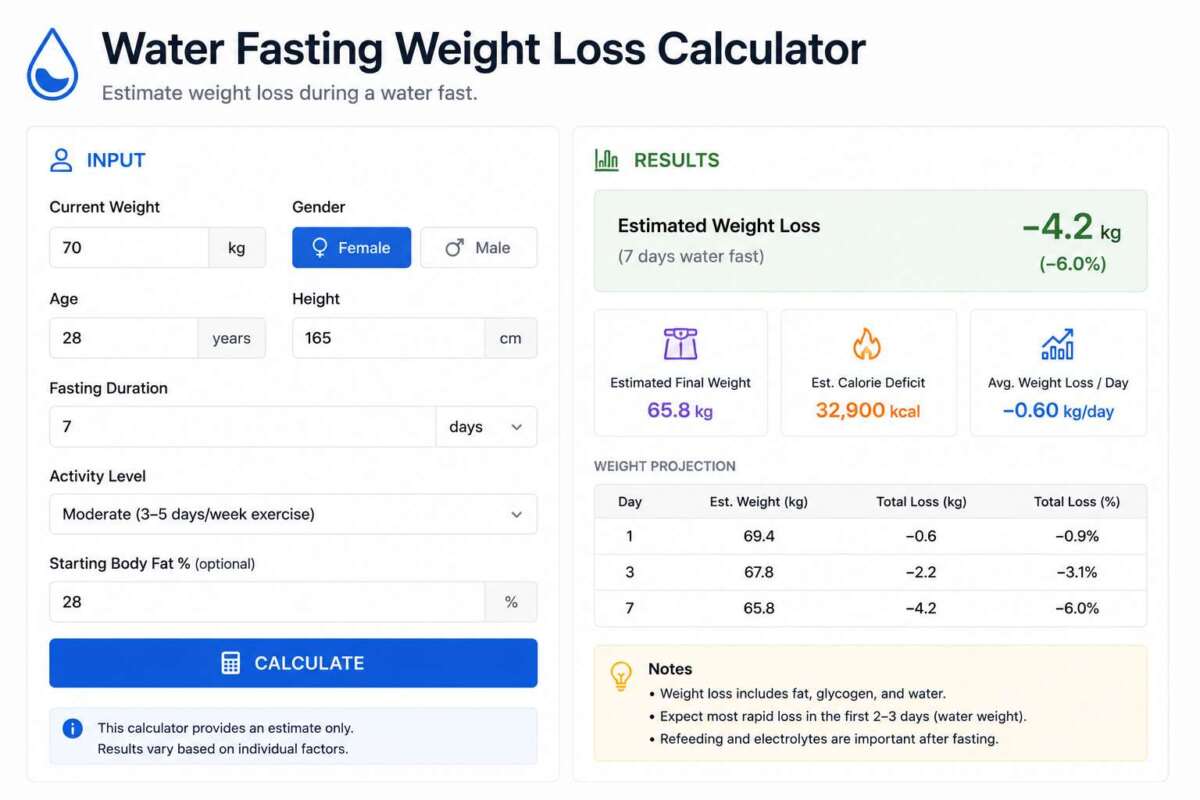
Use the BMR & Daily Deficit tab to estimate your baseline calorie burn, the Estimated Weight Loss tab to see a rough projection split between water/glycogen loss and fat-equivalent loss, or the Safety Check tab to see whether you should talk to a doctor before fasting — instantly.
Table of Contents
- Water Fasting Weight Loss Calculator (Free Tool)
- How Water Fasting Causes Weight Loss
- Water Weight and Glycogen vs. Fat Loss
- Who Should Not Water Fast Without Medical Supervision
- Risks of Extended Water Fasting
- Refeeding Syndrome: A Serious Risk After Fasting
- How to Break a Fast Safely
- Frequently Asked Questions
Water Fasting Weight Loss Calculator
Select a tab below. Educational estimates only — not medical advice, and not a substitute for consulting a doctor before fasting.
How Water Fasting Causes Weight Loss
With zero calorie intake, your body draws entirely on stored energy to meet its daily needs — starting with glycogen (stored carbohydrate in the liver and muscles), then increasingly shifting toward fat stores, and unfortunately also some lean tissue (muscle protein), as a fast continues. Your Basal Metabolic Rate (BMR) — the energy your body burns at complete rest just to maintain basic functions — represents roughly your daily calorie deficit while fasting, since there’s no food intake to offset it. The BMR & Daily Deficit tab above estimates this using the Mifflin-St Jeor equation, a widely used and validated formula for estimating resting energy expenditure from sex, age, weight, and height.
Water Weight and Glycogen vs. Fat Loss
This is the single most important thing to understand about early fasting weight loss: most of the dramatic weight drop in the first 1-3 days is water, not fat. Glycogen — your body’s stored carbohydrate reserve — is bound with roughly 3-4 grams of water for every gram of glycogen. As fasting depletes glycogen stores over the first couple of days, that bound water is released and lost along with it, producing a rapid initial drop on the scale that has nothing to do with fat loss.
Once glycogen is substantially depleted (typically within 24-72 hours for most people), further weight loss increasingly reflects the ongoing calorie deficit — a mix of fat breakdown and, unfortunately, some lean muscle tissue breakdown, since the body doesn’t exclusively burn fat even when it’s available. This is exactly why the scale number after a multi-day fast dramatically overstates actual fat loss, and why that water weight typically returns within days of resuming normal eating as glycogen stores refill.
Who Should Not Water Fast Without Medical Supervision
Water fasting is not appropriate for everyone, and some groups face genuinely serious risk without direct medical oversight:
- People with diabetes, particularly those on insulin or blood-sugar-lowering medication, face real risk of dangerous blood sugar swings.
- Pregnant or breastfeeding individuals, whose nutritional needs directly support a developing baby or milk production.
- Anyone with a current or past eating disorder, for whom fasting can trigger or worsen disordered eating patterns.
- People who are underweight or have limited fat/energy reserves to draw on safely.
- Anyone on prescription medication, especially blood pressure, heart, or blood-thinning medications, since fasting changes how the body processes many drugs.
- People with kidney disease, liver disease, heart disease, gout, or a history of gallstones, all of which fasting can meaningfully aggravate.
- Older adults, who generally have less physiological reserve to safely handle extended calorie and nutrient deprivation.
Use the Safety Check tab above as a starting screening reference, not a substitute for an actual conversation with a doctor familiar with your health history.
Risks of Extended Water Fasting
Beyond the first 24-72 hours, water fasting risk increases meaningfully. Documented risks of extended fasting include electrolyte imbalances (particularly sodium, potassium, and magnesium, which can affect heart rhythm), muscle and lean tissue loss as the body increasingly draws on protein for energy, gallstone formation (rapid weight loss is a known gallstone risk factor), dizziness, fatigue, and impaired concentration from low blood sugar and dehydration, and orthostatic hypotension (a drop in blood pressure on standing, increasing fall risk). This is exactly why credible medical guidance consistently recommends that fasts beyond 24-72 hours be conducted only under direct medical supervision, ideally with regular monitoring of vital signs and blood work.
Refeeding Syndrome: A Serious Risk After Fasting
Refeeding syndrome is a potentially life-threatening shift in fluid and electrolytes (particularly phosphate, potassium, and magnesium) that can occur when eating resumes after a period of significant calorie restriction or fasting, especially after longer fasts or in already-malnourished individuals. Reintroducing food — especially carbohydrate-heavy meals — too quickly and in too large a quantity can trigger this dangerous electrolyte shift, which can affect heart function and, in severe cases, be fatal. This risk is a major reason extended fasts should be medically supervised and broken gradually and carefully, not resumed with a large, normal-sized meal.
How to Break a Fast Safely
- Start small and go slow: A small amount of easily digestible food (broth, a small piece of fruit) is generally recommended before returning to normal meal sizes, especially after fasts longer than 24 hours.
- Avoid large, heavy, or very sugary meals immediately after a longer fast: This is precisely the scenario that raises refeeding syndrome risk.
- Rehydrate gradually with attention to electrolytes, not just plain water, particularly after fasts beyond a day or two.
- Watch for warning signs (swelling, confusion, irregular heartbeat, severe weakness) when resuming eating after an extended fast, and seek medical attention if they occur.
- For any fast beyond 24-72 hours, have a doctor involved in both the fasting period and the refeeding plan — this is the single most effective way to reduce the real risks discussed above.
Frequently Asked Questions
How much weight can I actually lose water fasting?
The scale number can move quickly — often several pounds in the first few days — but a large share of that early loss is water and depleted glycogen, not fat. Use the Estimated Weight Loss tab above to see a rough split between water/glycogen loss and fat-equivalent loss based on your BMR and fast duration, keeping in mind this is an estimate with real individual variation.
Is water fasting safe?
Short fasts (roughly 24 hours) are generally lower-risk for most healthy adults, though individual circumstances still matter. Longer fasts carry meaningfully higher risk — electrolyte imbalances, muscle loss, gallstones, and refeeding syndrome among them — and credible medical guidance recommends medical supervision for any fast beyond 24-72 hours. Certain groups (people with diabetes, pregnant or breastfeeding individuals, those with a history of eating disorders, and several other categories covered above) should not water fast without direct medical involvement, and in some cases shouldn’t fast at all.
Why does weight come back so quickly after a fast?
Because much of what was lost was water bound to glycogen, not fat — as soon as you resume eating carbohydrates, glycogen stores refill and pull that water back with them, often within just a few days. This is normal and expected, not a sign that the fast “failed” or that fat was regained.
What is refeeding syndrome and why does it matter?
Refeeding syndrome is a potentially serious, sometimes life-threatening shift in electrolytes that can occur when food is reintroduced too quickly after a significant fast, particularly a longer one. It’s a key reason extended fasts should involve medical guidance for both the fasting period and how eating is resumed afterward, rather than simply eating normally again as soon as the fast ends.
Should I talk to a doctor before trying water fasting?
For anything beyond a short, well-hydrated fast of about a day, yes — and for several groups covered in the Safety Check tab above (diabetes, pregnancy, eating disorder history, being underweight, certain medications, and several medical conditions), a doctor’s involvement isn’t just recommended, it’s important for safety. This calculator’s Safety Check tab is a general screening reference, not a substitute for an actual medical evaluation.
As an Amazon Associate, We earn from qualifying purchases. When you purchase a product through Amazon links on pulsefitguide.com, we may earn a small commission at no extra cost to you. This helps support the site and keep our content free.
