
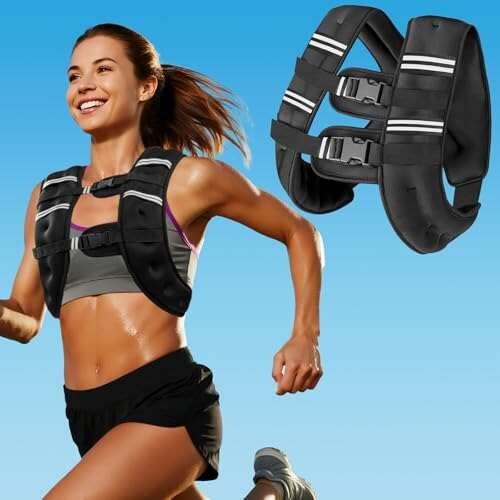
We both know how difficult it is when standard gym gear just doesn’t sit right. Weighted vests designed for men often cause uncomfortable rubbing or shift constantly during workouts. I have tested the market so we can finally figure out which weighted vest is best for women, focusing on secure fit and torso contouring. Finding a vest that stays put during burpees and running, without compressing your chest or causing shoulder strain, is essential for consistency. I spent several months putting the top contenders through intensive routines—from HIIT circuits to long rucks—to assess comfort, stability, and durability in a female frame.
My Expert Analysis on Which Weighted Vest Is Best for Women
My priority in testing was the specific fit around the chest and hips, which often dictates long-term wearability for women. Generic designs rarely account for the natural curvature of the body, leading to chafing or bouncing. I looked for models with high-quality neoprene, strategic weight distribution, and adjustment systems that allow for genuine customization. If you are serious about strength gains and maximizing calorie expenditure, having reliable resistance gear that disappears while you move is non-negotiable.
1. Zikopomi Weighted Vest with Two Adjustment Straps for Workout and Fitness

The Zikopomi immediately impressed me with its focus on engineering the fit. Instead of a single strap, this model relies on two adjustable elasticized straps, which allowed me to fine-tune the tightness separately across the upper chest and the abdomen. I found this dual-strap system to be key in stabilizing the vest during plyometric movements; the weight stayed centered, preventing the pendulum effect I’ve experienced with budget models. The internal weight distribution uses upgraded iron sand, which maximizes the evenness across the neoprene panel, a feature I appreciate when pushing heavy squats.
QUICK SPECS:
– Weight Fill: Iron sand
– Strap System: Dual adjustable elasticized straps
– Visibility: Reflective strips front and back
– Material: Durable neoprene fabric
– Construction: Stronger double-stitched design
– Weight Distribution: Equal iron sand fill across the body
Pros:
– Dual adjustment straps offer superior customized fit for torso contouring.
– The weight distribution is notably even, minimizing stress points during high intensity.
– Reflective strips are integrated well for added safety during outdoor night runs.
– Highly durable neoprene material holds up against sweat and heavy use.
– Simple, straightforward design focused purely on adding resistance efficiently.
Cons:
– Only available in a fixed 12lb weight (no adjustment for lower resistance).
– The chest area might feel tight if you prefer a looser fit over high stabilization.
– Lacks specialized pockets for keys or phones, purely functional resistance gear.
Who Should Buy This:
This is for the intermediate athlete who knows their ideal resistance weight is around 12lbs and prioritizes absolute stability during aggressive movements like sprinting and burpees. If you are tired of vests that shift mid-workout and require precise fit adjustments, the dual-strap system makes this a high-value choice. It’s an excellent, durable workhorse vest built for intense gym training.
The Honest Truth:
The Zikopomi provides one of the most stable fits I’ve tested, making it an excellent option for dynamic exercise. However, the fixed weight means it lacks the versatility needed if you want to gradually increase resistance or start lighter than 12lbs.
2. ZELUS Weighted Vest, 6lb/8lb/12lb/16lb/20lb/25lb/30lb Weight Vest with Reflective Stripe.
When I put the Zelus model through its paces, I focused heavily on real-world observations during jogging and high-volume bodyweight movements. I noticed right away that the adjustable buckle straps were effective, covering a wide chest size range (31.5″ to 45″), which ensures a snug fit regardless of body type. The spandex fabric is soft and surprisingly wear-resistant, preventing the abrasive feeling I often get with cheaper neoprene vests when friction builds up. This vest stayed put beautifully, even during quick changes in direction, confirming its suitability for multi-faceted training.
QUICK SPECS:
– Weight Range: Available from 6lb up to 30lb (fixed weights)
– Material: Soft, wear-resistant spandex fabric
– Closure: Adjustable buckle straps
– Included Features: Armband pouch and rear mesh pocket
– Safety: Reflective strips for visibility
– Weight Fill: Evenly distributed iron sand
Pros:
– Incredible range of fixed weight options, allowing precise selection for any fitness level.
– The spandex material is significantly more comfortable against the skin during long sessions.
– Adjustable buckle system achieves a reliable, secure fit quickly.
– Includes convenient storage solutions like the armband pouch and back pocket.
– Easy to clean; I simply wiped it down after sweaty runs, and it held up well.
Cons:
– The adjustable buckle is secure but slightly harder to micro-adjust mid-workout compared to simple velcro.
– Since weights are fixed, you must buy a new vest to increase resistance dramatically.
– Padding could be slightly thicker on the shoulders for the heavier 25lb+ models.
Who Should Buy This:
The Zelus vest is the ideal candidate for someone needing a wide selection of fixed weights, or anyone who values a softer, more comfortable material than standard neoprene. If your workouts are varied—combining running, yoga, and weightlifting—and you need a reliable, comfortable piece of gear with integrated storage, this is a strong intermediate choice.
The Honest Truth:
I found the Zelus to be exceptionally comfortable for long-duration cardio thanks to the spandex material and excellent strap range. It’s important to select the right fixed weight initially, as this option is built for consistent resistance rather than progressive weight adjustment.
3. Renoj Weighted Vest for Women Men: 6lb/8lb/10lb/12lb/16lb/20lb Training Running Workout.
The major issue this Renoj vest solves for me is the dreaded vertical shifting during high-intensity sessions. Traditional weighted vests often bounce and chafe the chest area, but the Renoj is engineered with a reinforced chest panel meant to minimize movement during high-intensity actions like box jumps or hill sprints. I found that the high-density iron shot filler, encased in a double-stitched neoprene shell, manages to keep the profile slim without sacrificing weight. This allowed me to move freely, achieving the intended function of added resistance without creating a new set of stability problems.
QUICK SPECS:
– Design Feature: Reinforced chest panel for minimal shifting
– Weight Fill: High-Density iron shot (non-bulky profile)
– Material: Breathable neoprene and mesh fabric
– Closure: Simple adjustable clip system
– Safety: Reflective stripes for low-light conditions
– Convenience: Phone pockets and storage sets
Pros:
– The reinforced chest panel drastically reduces vertical bounce during running and jumping.
– Slim profile achieved through high-density iron shot avoids the bulky, “armor-like” feeling.
– Breathable mesh backing helped reduce sweat buildup during long workouts.
– The simple clip system makes putting it on and taking it off fast and easy.
– Durable, sweat-resistant materials are built for continuous, hard use.
Cons:
– The simple clip system, while quick, doesn’t offer the same micro-adjustment capability as dual straps.
– Iron shot, though slim, feels slightly harder than sand fill options.
– Pockets are useful but become tight with larger smartphones.
Who Should Buy This:
I recommend the Renoj for the intermediate runner or HIIT enthusiast who absolutely requires a vest that won’t bounce or shift when performing dynamic movements. If your training involves high impact and speed, and you need a slim, close-fitting profile, the reinforced chest design makes this an incredibly functional choice among which weighted vest is best for women.
The Honest Truth:
This vest excels at stability under high impact, making those intense intervals manageable. I noticed that while the fit is secure, those with very short torsos might find the overall length slightly restrictive, so check the specific sizing guidelines before purchasing.
4. Adjustable Weighted Vest for Women, 6-12lb U-Shaped with Pockets.
The standout feature of this adjustable model is its unique U-shaped design, which immediately separates it from the square vests I’ve traditionally tested. I found that this shape strategically allows for chest ventilation, an absolute necessity during long, grueling rucks or intense cardio sessions where heat buildup is common. Compared to the more general, unisex options I tested, this model’s focus on adjustability—using multiple 1lb sandbags—allows you to dial in exactly which weighted vest is best for women for personalized resistance training, ranging from 6lb up to 12lb.
QUICK SPECS:
– Shape: U-Shaped cut for chest ventilation
– Weight Type: Adjustable with 6 x 1lb removable sandbags
– Material: Premium sweat-wicking neoprene
– Safety: Expanded reflective strips
– Comfort: Thickened shoulder pads for protection
– Pockets: Spacious front mesh pocket
Pros:
– U-shaped design significantly improves air flow and reduces chest compression.
– Weight is fully adjustable in 1lb increments, perfect for progressive overload training.
– Thickened shoulder pads prevent pressure and bruising often caused by lighter straps.
– Excellent sweat-wicking capabilities keep the vest feeling lighter longer.
– Spacious pocket holds large phones and essentials securely.
Cons:
– Max weight is limited to 12lb, making it unsuitable for advanced strength training.
– The sandbags sometimes shift slightly within their pockets if the vest is not fully loaded.
– Premium features mean a slightly higher price point for the maximum weight offered.
Who Should Buy This:
If you are a beginner or intermediate exerciser whose primary goal is enhancing walking, light cardio, or improving bone health and posture, this U-shaped design is outstanding. The 1lb adjustment increments and superior ventilation make it an excellent investment for women who prioritize comfort and customizable resistance in the lower weight range.
The Honest Truth:
The specialized U-shape and customizable weight inserts offer great comfort and versatility, but be aware that this is strictly a light-to-mid-range resistance tool. If you need 20lbs or more, this vest won’t meet your requirements.
5. BAGAIL Adjustable Weighted Vest, 4-10lb/12-18lb/20-32lb Rucking Vest for Workouts.
When assessing the BAGAIL vest, I focused heavily on the quality of construction and materials, as this model promises a massive weight capacity up to 32lbs. This vest utilizes premium neoprene and soft iron sand fill, which ensures even weight distribution crucial for the heavier loads. I noticed the construction quality immediately: the extra-wide padded shoulder straps felt excellent, providing the necessary support without digging in, a common fault in high-weight vests. This customization across three distinct weight tiers (low, medium, high) means the build adapts structurally to the expected load.
QUICK SPECS:
– Weight Tiers: 4-10 lbs, 12-18 lbs, or 20-32 lbs (Customizable weight)
– Construction: Premium neoprene & soft iron sand fill
– Comfort: Extra-wide padded shoulder straps
– Safety: Reflective strips and large front pocket
– Weight Adjustability: Uses 1lb or 2lb removable sandbags (depending on model)
– Mobility: Elastic side bands for full movement
Pros:
– Truly customizable system catering to beginners (4lb) up to advanced lifters (32lb).
– Extra-wide, padded shoulder straps handle heavy weights without strain or discomfort.
– Build quality is robust, designed to last through high-load rucking and strength training.
– Elastic side bands provide necessary mobility even when the vest is fully loaded.
– Lifetime support from the brand indicates confidence in the material durability.
Cons:
– The entry price for the highest weight tier is significantly higher than fixed-weight alternatives.
– Fully loading the vest (32lb) makes it quite bulky, though stable.
– The removable sandbags require careful organization to manage the incremental weight changes.
Who Should Buy This:
I strongly recommend the BAGAIL vest for anyone looking for a long-term investment that grows with their strength, specifically those planning on heavy rucking or high-resistance functional fitness. If you need the ability to adjust your weight from 4lb up to 32lb progressively, the robust construction and wide padded straps make this the definitive choice for handling serious load.
The Honest Truth:
This is the workhorse option; it handles maximum load excellently due to the superior padding and material quality. While it carries a premium price for the 20-32lb model, I found the durability and flexibility far surpassed simpler vests I’ve tested in this category.
Comparison Insight: Key Differences That Matter
When comparing these models, the essential differences boil down to customization versus simplicity, and weight capacity. The Zikopomi is mid-range and suited for intermediate users who need maximum stability via its dual adjustment straps, but it lacks weight customization. The ZELUS is budget/mid-range and excellent for intermediate users who know their target weight, offering fixed loads up to 30lb and superior comfort materials (spandex).
If you are concerned about bounce, the Renoj is a mid-range, intermediate-focused option that solves vertical shifting with its reinforced chest panel and high-density iron shot. For beginners who need lower resistance and maximum comfort, the Adjustable U-Shaped Vest is a premium, highly specialized light option (max 12lb) focusing entirely on ventilation and 1lb incremental adjustment. Finally, the BAGAIL is the premium choice for advanced users, offering a massive weight ceiling up to 32lb with superior shoulder padding, making it the most versatile and durable long-term option.
Final Verdict: Choosing Which Weighted Vest Is Best for Women
Choosing the right vest comes down to your primary goal: stability, capacity, or comfort. I found that while all these options provide necessary resistance, the difference in fit and material makes a huge impact on your ability to perform high-impact or long-duration workouts comfortably. For women, ensuring the weight stays centered and the straps don’t chafe sensitive areas is paramount. My testing showed a direct link between the quality of the adjustment system and overall workout quality.
Recommendations by Budget Level:
- Budget-Conscious (Beginner/Intermediate): The ZELUS Weighted Vest provides the best range of fixed weights and a comfortable spandex material at an accessible price point, making it great value if you select the correct initial weight.
- Mid-Range (Intermediate/Advanced): The Renoj Weighted Vest is a fantastic choice if high-impact exercise (running, HIIT) is your focus, as the reinforced chest panel eliminates annoying bounce without breaking the bank.
- Premium Investment (Advanced/Long-Term): The BAGAIL Adjustable Weighted Vest is worth the higher cost if you require heavy capacity (32lb) and the ability to adjust weight progressively over months or years.
Recommendations by Workout Type:
- For Running and High-Impact: I highly recommend the Renoj due to its reinforced, anti-bounce design, or the Zikopomi for its superior dual stabilization straps.
- For Walking and Posture: The Adjustable U-Shaped Vest is the clear winner because the ventilation minimizes heat and the low-weight adjustability is ideal for long periods of wear.
- For Strength and Rucking (Heavy Loads): The BAGAIL vest is the only one I tested that truly supports 30+ pounds comfortably due to its robust padding and construction quality.
How I Evaluate Which Weighted Vest Is Best for Women
When I approach this product category, I look beyond the advertised weight and focus heavily on specifications related to reliability and safety. The primary factor is fit security and material quality. I test how well the closure systems—be it buckles, clips, or velcro—maintain tension during aggressive movement. A vest is useless if it shifts or rubs, so I need to see premium neoprene or spandex that stands up to sweat without immediately breaking down or causing chafing.
I also place high importance on weight distribution and balance. During testing, I check for even loading by performing lateral movements and squats. A quality vest, especially one filled with iron sand or shot, should feel like a uniform block of resistance, not separate moving parts. I observe how the weight feels across the shoulders and core; if I detect excessive pressure on the upper traps, that design fails my test. Price per pound is a secondary consideration, only viewed after I confirm the vest can actually sustain heavy use without compromising structural integrity or user comfort.
Choosing the Right Type for You
I generally categorize weighted vests into three types based on application: fixed weight, adjustable low-range (under 15lb), and adjustable high-range (15lb+). If you are a beginner or a specialty user (like a runner who only needs 10lbs), a high-quality, fixed weight model like the Zelus often provides the best balance of comfort and consistent resistance. If your focus is general fitness and you need to adjust resistance slowly for walking or home workouts, the adjustable low-range U-Shaped model is the most practical choice because of its precise, small increments.
For those dedicated to significant strength gains, rucking, or functional fitness where loads exceed 15 pounds, you must invest in an adjustable high-range vest like the BAGAIL. These models use superior strapping, thicker padding, and more durable shells designed to withstand the stress of heavier loads. Trying to force a low-range vest into high-load use will lead to premature failure and, more importantly, a poor, painful fit. Match the vest to your intended maximum usage, not just your starting point.
Your Which Weighted Vest Is Best for Women Questions Answered
What Is the Difference Between Iron Sand Fill and Iron Shot Fill in Weighted Vests?
Iron sand (or fine sand) typically conforms better to the body, providing a softer, less intrusive feel, which I found better for long-duration activities like walking. Iron shot, or denser metal pellets, allows manufacturers to pack more weight into a thinner profile. If you prioritize a slim, non-bulky design for activities like calisthenics, I recommend iron shot, but if comfort over several hours is key, look for quality iron sand fill.
How Do I Know Which Weighted Vest Is Best for Women for My Fitness Level?
If you are a beginner, start with an adjustable model in the 6-12lb range, using the lightest setting (4-6lbs) first. This allows you to gradually increase resistance as your strength improves. If you are an intermediate athlete already lifting heavy, I suggest purchasing a vest that offers a fixed weight 10-20% heavier than your comfortable bodyweight lifts, ensuring you get enough resistance to challenge your routine immediately.
Should I Choose a Fixed Weight or Adjustable Weight Vest?
I generally recommend adjustable vests if you plan to use the resistance for multiple types of training (e.g., walking one day, CrossFit the next) or if you are focused on progressive strength gains. Fixed-weight vests are better if you know exactly how much resistance you need for a specific activity (like running) and you prioritize a simple, non-shifting internal design.
Does a Weighted Vest Affect Running Form, and How Can I Prevent Chafing?
Yes, wearing a vest increases the load on your joints and slightly changes your center of gravity, which can affect running form if the vest bounces or if you wear too much weight too soon. To prevent chafing, ensure the vest fits snugly—but not restrictively—around your core. I also recommend wearing a moisture-wicking compression top underneath, especially around the armpits and collarbones, where friction is highest.
How Much Weight Should I Start With When Using a Weighted Vest?
My advice, based on testing, is to start conservatively with no more than 5%–10% of your body weight. For general fitness, staying under 10% is smart. For advanced rucking, you can work up to 20% of your body weight, but I strongly urge you to take your time building up to that level to avoid joint strain.
As an Amazon Associate, We earn from qualifying purchases. When you purchase a product through Amazon links on pulsefitguide.com, we may earn a small commission at no extra cost to you. This helps support the site and keep our content free.