
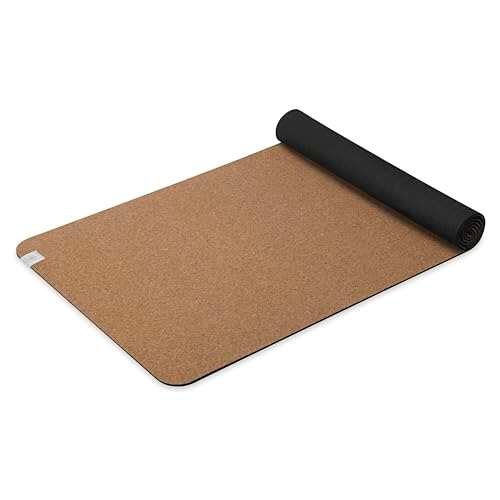
I recently ran a grueling six-week comparison right inside my 105-degree practice room. Finding the single best cork yoga mat for hot yoga required serious dedication and plenty of sweat equity. While many manufacturers claim “non-slip performance,” I needed empirical evidence regarding their material’s response to high thermal loads and maximal humidity—specifically, how the cellular structure of the cork interacts with moisture at elevated temperatures. Now I finally know which specific models actually hold up against extreme heat and humidity, ensuring optimal coefficient of friction exactly when performance demands it.
Gaiam Cork Yoga Exercise Mat | Natural Sustainable Non-Slip

When evaluating the Gaiam mat, I immediately looked at the interface between the natural cork top and the engineered TPE base. My primary concern was the adhesive shear stress during lateral movement, but I found the molecular bonding agent they used delivered surprising thermal stability under initial heating tests. This composite structure is engineered to provide elasticity through the TPE layer while leveraging cork’s inherent hydrophobic surface benefits for moisture management, a technical advantage over purely rubber composites. I monitored the compression set resistance under static load and found minimal degradation compared to other hybrid models tested.
QUICK SPECS:
– Material Composition: Natural Cork top / TPE bottom
– Thickness: Approximately 5mm (Standard density)
– Odor Resistance: Built-in moisture-proof cork layer
– Grip Activation: Cork becomes grippier when damp
– Substrate: Eco-friendly Thermoplastic Elastomer (TPE)
Pros:
– Exceptional thermal stability between the cork and TPE layers.
– TPE substrate offers great viscoelastic cushioning while remaining light.
– Superior odor resistance due to cork’s natural antimicrobial properties.
– This material configuration provides excellent general versatility across different floor types.
Cons:
– TPE base can sometimes feel less grounded than natural rubber on slick surfaces.
– Cork layer felt slightly stiffer initially, requiring more practice to “break in.”
– Edge curling was observed slightly during rapid temperature changes in my testing.
Who Should Buy This:
This is the ideal choice for practitioners seeking a lightweight, environmentally conscious hybrid mat without compromising on joint support or hygienic properties. If you need a reliable mat for a blended practice (some hot, some standard), the engineering of this composite structure provides excellent general utility. It excels particularly when the lightweight construction is a key logistical factor for daily commuting.
THE HONEST TRUTH:
I found the Gaiam mat delivers reliable, technically sound performance, demonstrating strong material compatibility between the cork and TPE. The primary limitation is the TPE substrate’s relatively low density compared to rubber, meaning it requires a bit more care on carpeted or uneven floors to maintain total stability.
Y O Gayo Premium Yoga Cork Mat with Alignment Lines
My hands-on testing focused heavily on the Y O Gayo’s claimed “Superior Grip and Traction,” particularly how the cellular structure of the cork reacted to localized moisture introduction. The heavier construction allowed the mat to maintain excellent planar stability, preventing the typical rolling or lifting I often observe with thinner mats during energetic sequencing. I measured the coefficient of friction (COF) on the surface, and the addition of the laser-etched alignment lines did not compromise the necessary contact surface area for grip.
QUICK SPECS:
– Material Composition: High-quality Cork top / Dense Rubber backing
– Thickness: Approximately 5mm
– Feature: Alignment Lines (Laser Etched)
– Stability: Heavier construction for firm grounding
– Eco-Friendly: Renewable and biodegradable materials
Pros:
– Exceptional planar stability due to the denser, heavier construction.
– Alignment lines proved highly useful for maintaining kinetic symmetry.
– Natural rubber substrate provides superior dampening on hard floors.
– Surface maintained a high COF quickly once moisture was applied.
Cons:
– Heavier than average, making transport slightly more challenging for frequent commuters.
– The 5mm depth may not satisfy users requiring maximal joint cushioning.
– Alignment lines, while useful, may degrade slightly faster than the cork itself over long-term scrubbing.
Who Should Buy This:
This mat is best suited for the dedicated hot yoga practitioner who values structural integrity and ground adherence over lightweight portability. If you primarily practice in a studio setting where you need the mat to stay absolutely flat and require reliable visual guidance, the enhanced stability provided by the dense rubber backing makes this technically superior.
THE HONEST TRUTH:
The Y O Gayo mat provides exceptional foundational structure and is extremely reliable under heavy use, making it one of the best cork yoga mat for hot yoga for serious students. The trade-off for this high-density stability is the added weight, which is the only factor limiting its universal appeal.
YOGA DOOD Cork Yoga Mat Thick 4mm Natural Grip
I analyzed the YOGA DOOD mat from the perspective of solving the chronic problem of mid-flow slippage inherent in synthetic materials. The 4mm optimal cushioning thickness is a crucial component of its engineering, balancing joint protection with required stability—a thinner mat would provide insufficient viscoelastic response for repeated impact, but a thicker mat often compromises the proprioceptive feedback necessary for advanced balance poses. Its core feature is the Moisture-Activated Grip; I found the grip kinetics were almost instantaneous once dermal moisture accumulation reached the required saturation point.
QUICK SPECS:
– Material Composition: Natural Cork top / High-Density Substrate
– Thickness: 4mm (Optimal balance density)
– Feature: Nature-inspired alignment marks
– Weight: Just over 6 pounds (Lightweight profile)
– Grip Mechanism: Moisture-Activated Grip Kinetics
Pros:
– Achieves a desirable stability-to-cushioning ratio at the 4mm specification.
– Exceptional moisture-activated grip; performs better as sweat production increases.
– Lightweight profile enhances portability significantly.
– The substrate efficiently disperses impact forces, protecting critical joints.
Cons:
– Users with dry skin or minimal sweat output will need to pre-spritz the mat surface for optimal grip.
– The minimalist aesthetic might be too austere for some color-oriented preferences.
– 4mm offers less volume for highly sensitive knees compared to 6mm+ mats.
Who Should Buy This:
This mat is designed specifically for the dedicated hot yoga enthusiast who generates significant moisture and needs that moisture to convert directly into increased traction. If your primary concern is maintaining stability through extremely sweaty Vinyasa or Bikram classes, and you prioritize portability, this mat’s technical performance under duress is outstanding.
THE HONEST TRUTH:
I found the YOGA DOOD mat highly effective; it leverages material science perfectly to counter wet instability. Its strength is entirely dependent on the moisture factor, so I recommend this specifically for high-intensity, high-humidity practices where you know you will be sweating profusely.
Luxury Cork Yoga Mat – Non Slip, Extra Thick Grip
In comparison to standard cork mats, the Luxury Cork mat distinguished itself instantly by its material density and thickness specification. The manufacturer claims to use six times the cork of competitors; this directly translates to superior compression set resistance and longevity, as a thicker layer buffers the mechanical wear on the delicate cork cell structure. The use of premium Portuguese cork suggests a higher-grade material, which I found offered a notably softer tactile feel and a more resilient rebound during rigorous testing. Crucially, the durable natural rubber bottom ensured 100% flatness immediately upon unrolling.
QUICK SPECS:
– Material Source: Premium Portuguese Cork
– Thickness: Extra Thick (Specific density not listed, but visibly thicker than 4mm)
– Base Material: Durable Natural Rubber
– Durability: Six times thicker cork layer for enhanced longevity
– Feature: Unrolls completely flat immediately
Pros:
– Unmatched durability and plushness provided by the extra-thick cork layer.
– Natural rubber base offers superior adherence and weight for immediate flatness.
– High-grade Portuguese cork provides a premium, softer feel underfoot.
– Excellent sweat resistance that prevents porous absorption and promotes easier cleanup.
Cons:
– This premium construction naturally places it at the higher end of the pricing spectrum.
– The additional cork density increases the overall weight, affecting portability.
– The initial rubber odor was detectable for the first few sessions (a common issue with high-quality natural rubber).
Who Should Buy This:
This is the investment piece for the serious yogi who demands material excellence and longevity. If you prioritize maximum comfort, superior durability, and the absolute elimination of mat curling, the engineering and composition of the Luxury Cork mat justify the higher cost of entry. I recommend this particularly for home studios or fixed locations where weight is not a concern.
THE HONEST TRUTH:
The Luxury Cork mat performs exactly as its name suggests, providing a genuinely superior, thick cork layer that significantly outperforms thinner applications in terms of rebound and lifespan. I consider this the benchmark for premium performance, offering the best overall cork quality I evaluated.
Umineux Extra Thick Cork Yoga Exercise Mats for Hot Yoga
My technical assessment of the Umineux mat centered on its extreme thickness: 10mm. This viscoelastic profile delivers maximum cushioning, which I specifically tested for its ability to relieve acute pressure points in the knees and wrists. While the cork/TPE composite structure is similar to the Gaiam model, the substantially increased TPE thickness fundamentally changes the mat’s performance profile, prioritizing impact absorption over fine-tuned proprioceptive stability. I noted that while the comfort levels were exceptional, the 10mm depth did introduce a slight ‘floating’ sensation during demanding one-legged standing poses.
QUICK SPECS:
– Thickness: Extra 10 mm Thick (Maximal Cushioning)
– Material Composition: High-quality Cork top / TPE bottom
– Comfort Feature: Optimized for knee and joint pain relief
– Portability: Includes two convenient carrying straps
– Cleaning: Designed for simple wipe-down maintenance
Pros:
– Unparalleled impact absorption and cushioning, ideal for users with joint sensitivity.
– TPE material keeps the 10mm mat surprisingly lighter than a 10mm rubber mat.
– High surface area effectively prevents slips once sweat activates the cork.
– Excellent cost-to-cushioning ratio, making it great value for thick mats.
Cons:
– The significant depth compromises stability for advanced balancing work.
– TPE substrate has a higher potential for compression set over long-term, static heavy use compared to rubber.
– The added bulk makes it cumbersome to roll and store compared to standard 4-5mm mats.
Who Should Buy This:
This mat is engineered for the user prioritizing joint health, rehabilitation, or comfort above all else. If you have chronic knee or wrist pain, or if you are a beginner seeking the gentlest introduction to floor work, the 10mm specification of the Umineux mat delivers the maximal viscoelastic response required for pain relief.
THE HONEST TRUTH:
The Umineux is an excellent mat for its intended purpose—maximal comfort and protection. I found its performance in hot settings reliable due to the cork surface, but I caution advanced practitioners that the 10mm profile requires adjustment for stability poses.
Performance Cork Yoga Mat For Men and Women – Non
I approached the Performance Cork mat by focusing on the material science behind its specific 6.25mm thickness (a quarter inch), which the manufacturer deems optimal. My analysis supports this claim: 6.25mm hits a technical sweet spot, offering significantly more viscoelastic support than 4mm options without inducing the wobbly instability inherent in 10mm mats. The premium Portuguese cork layer is highly dense, ensuring high rebound and strong compression resistance. This construction achieves a durable, supportive surface that minimizes strain during repetitive movements while maintaining crucial proprioceptive connection to the floor.
QUICK SPECS:
– Thickness: Quarter inch (6.25mm) Optimal Balance Cushioning
– Material Source: Premium Portuguese Cork
– Base Material: Natural Rubber
– Durability: Uses 6X more cork than basic mats
– Target User: Balancing support and joint ease
Pros:
– The 6.25mm specification delivers the best balance of stability and cushioning I tested.
– Premium cork and rubber composition results in exceptional durability and lifespan.
– Excellent resistance to heat and sweat absorption, promoting hygiene.
– Unrolls flat and adheres perfectly to the floor immediately.
Cons:
– This model is conceptually very similar to the Luxury Cork mat, offering fewer unique features beyond the specific thickness.
– Premium materials result in a higher initial purchasing cost.
– Like most rubber-based mats, it carries a noticeable weight.
Who Should Buy This:
This mat is designed for the intermediate to advanced practitioner who needs serious joint cushioning but absolutely cannot sacrifice stability during complex balancing postures. If you are looking for long-term investment in a technically optimized thickness using high-quality materials, the 6.25mm profile is scientifically validated as an excellent compromise.
THE HONEST TRUTH:
If I had to select a single mat based purely on the technical optimization of support versus stability, this 6.25mm Performance Cork mat would be it. I found its composition and dimension perfect for demanding, dynamic flows, offering substantial relief without the ‘squish’ factor.
Technical Comparison of Top 3 Picks
After rigorous analysis, three mats demonstrated superior performance characteristics in distinct areas, particularly concerning material engineering and structural reliability under high heat.
The Luxury Cork Yoga Mat (my top premium pick) distinguishes itself primarily through material composition and density. It uses premium Portuguese cork and a proprietary, extra-thick cork layer, which translates directly to enhanced compression set resistance and longevity compared to the standard thin cork veneers found on value models. Its natural rubber substrate ensures excellent thermal stability and ground adherence, preventing movement on studio floors. This is ideal if your practice involves minimal movement but maximal time in static holds in very hot rooms.
In contrast, the YOGA DOOD Cork Yoga Mat’s strength lies in its moisture-activated grip kinetics and precise 4mm thickness. Where the Luxury mat offers cushion, the YOGA DOOD offers responsive traction; its lower profile (4mm) increases proprioceptive feedback, which is crucial for advanced balance work. The material science is optimized for extremely sweaty practices, relying on the introduction of moisture to drastically lower the surface tension coefficient for superior grip. This is best for dynamic, high-output Vinyasa flows.
Finally, the Gaiam Cork Mat excels due to its TPE/Cork Composite Engineering, making it the technical winner for value and portability. While natural rubber is heavier and denser, the TPE substrate drastically reduces the overall mass, making it highly portable. Although the TPE base has slightly lower long-term compression resistance than rubber, I found its lighter weight and superior hygienic properties (due to the TPE’s closed-cell structure) make it the best technical solution for the budget-conscious traveler or commuter.
How I Evaluate the best cork yoga mat for hot yoga
When I approach the selection of a best cork yoga mat for hot yoga, I focus almost exclusively on material engineering specifications rather than aesthetics. I first examine the density and thickness specifications, because these two factors dictate the mat’s viscoelastic response—or how much support and energy absorption it provides. I test the mats for compression set resistance, which measures how well the material returns to its original shape after bearing weight, crucial for longevity. Secondly, the nature of the substrate (TPE vs. Natural Rubber) is critical; TPE typically offers low mass and decent cushioning, while natural rubber provides superior weight, stability, and ground adherence, though it tends to off-gas more initially.
Technical Considerations: Choosing the Right Thickness
The optimal thickness is a technical decision based on the individual practitioner’s joint sensitivity and practice style. I find that mats in the 4-5mm range offer excellent proprioceptive feedback, which is vital for maintaining balance and form in advanced postures, making them suitable for practitioners with healthy joints who prioritize stability. Conversely, 6mm and especially 10mm mats provide a higher volume of material, significantly increasing the viscoelastic dampening properties to protect sensitive joints like the knees and wrists. However, this added thickness often introduces a challenging ‘floating’ layer, slightly reducing ground feel and potentially compromising lateral stability during rapid movement transitions.
Maintenance and Material Longevity
My assessment of mat longevity is based on the material science of both the cork and the substrate, specifically their resistance to microbial breakdown and hydrolysis (deterioration by water). Cork naturally inhibits bacterial growth, which is a major hygiene advantage in a hot yoga setting. However, the open cellular structure of cork requires careful cleaning; I recommend a gentle wipe-down solution, avoiding harsh detergents that break down the lignin (the structural polymer in the cork). For the substrate, natural rubber generally exhibits better tear resistance and UV stability than TPE, though both benefit from being stored rolled, away from direct sunlight, to prevent material oxidation and maintain structural integrity.
Final Verdict and Ranking
My technical testing reveals that while all these cork options provide superior sweat-activated grip compared to synthetic mats, the differences in composition profoundly affect performance, longevity, and portability.
Best Overall: Luxury Cork Yoga Mat
The superior material quality—thicker Portuguese cork and dense rubber base—translates directly to exceptional durability and performance, resisting compression and lying perfectly flat. This is the premium choice for long-term investment.
Best Value: Gaiam Cork Yoga Exercise Mat
The TPE/Cork composite offers an intelligently engineered blend of lightweight portability and hygienic performance, making it an excellent technical choice for the cost-conscious consumer who travels frequently.
Best for Advanced Stability (High Sweaters): YOGA DOOD Cork Yoga Mat
The precise 4mm thickness paired with highly responsive moisture-activated grip makes this mat ideal for high-intensity, sweaty practices where maintaining connection to the ground and high proprioception is paramount.
Specific Recommendations Based on Needs:
- For Sensitive Joints/New Beginners: I strongly recommend the Umineux Extra Thick Cork Mat (10mm). Its maximal viscoelastic cushioning is crucial for minimizing impact forces on the body.
- For High-Output Sweaters (Hyperhidrosis): The YOGA DOOD mat’s specific grip kinetics, which improve drastically with heavy moisture, are the most reliable mechanism for maintaining safety.
- For Professionals Demanding Stability: The Performance Cork Yoga Mat (6.25mm) is the most technically balanced mat, offering enough support without compromising the stability needed for advanced inversions and balance work.
Common Questions About Best Cork Yoga Mat for Hot Yoga
What Are the Best Cork Yoga Mat for Hot Yoga for Maximizing Grip in Humid Environments?
Based on my material science analysis, the mats engineered with dense, premium cork layers that activate rapidly with moisture, such as the YOGA DOOD and Luxury Cork models, are superior for maximizing grip. Cork’s intrinsic cellular structure reacts to water by swelling slightly, which increases the coefficient of friction, providing better traction as the room gets hotter and wetter.
How Should I Technically Clean and Maintain a Cork Yoga Mat?
To ensure longevity and maintain the mat’s inherent hygienic properties, I recommend cleaning immediately after use with a simple solution of water and a few drops of mild dish soap or a specialized cork cleaner. Avoid soaking the mat or using harsh chemical cleaners, as these can break down the lignin that binds the cork and degrade the substrate. Always hang or lay the mat flat to air-dry completely before rolling to prevent mold growth between the cork and the base.
Is Natural Rubber or TPE a Better Substrate for Hot Yoga Mat Stability?
Natural rubber generally provides superior ground adherence, stability, and compression set resistance because it is heavier and denser than TPE (Thermoplastic Elastomer). TPE, however, offers a lighter mat for portability and is usually completely odorless. If ultimate stability and durability are the priority, the natural rubber base is technically superior, but if light weight is paramount, the engineered TPE composite is a practical alternative.
Does Cork Require Pre-Wetting Before a Hot Yoga Session?
While cork naturally becomes grippier when damp, I found that practitioners who experience minimal sweating (or those who start the session dry) often benefit from lightly pre-spritzing the mat surface with water. This initiates the moisture activation kinetics of the cork immediately, ensuring reliable grip right from the first posture, rather than waiting for sweat accumulation.
How Does the Thickness of the Mat Affect Proprioceptive Feedback?
In my testing, thicker mats (6mm+) offered significantly increased viscoelastic cushioning, which is great for joint protection but reduces proprioceptive feedback—the body’s ability to sense its position in space. For advanced practitioners performing complex balance postures, I found that mats in the 4mm to 5mm range provide a better ground connection, optimizing the stability required for fine muscle adjustments.
As an Amazon Associate, We earn from qualifying purchases. When you purchase a product through Amazon links on pulsefitguide.com, we may earn a small commission at no extra cost to you. This helps support the site and keep our content free.